
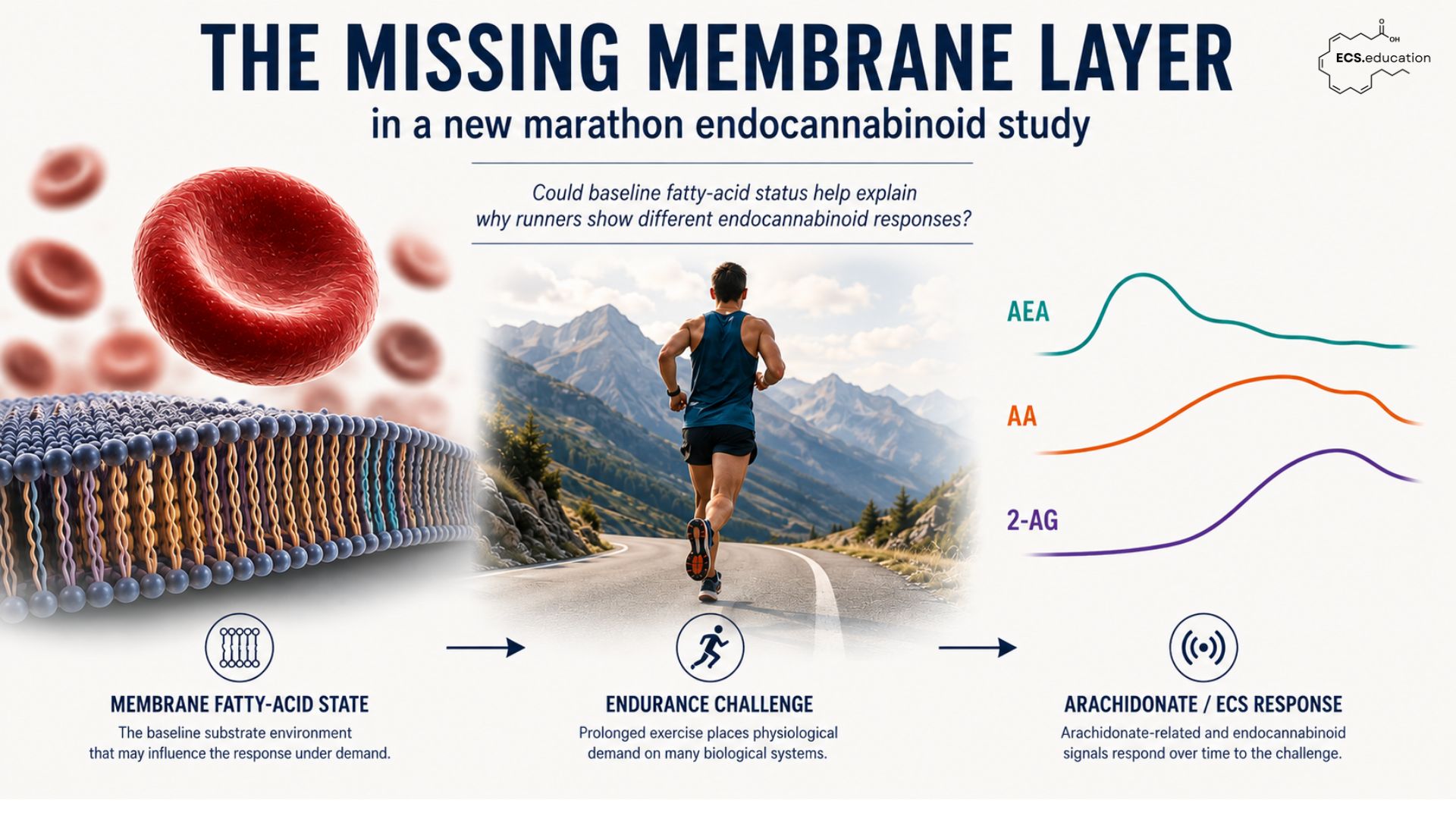
What the new study found about the endocannabinoid system and endurance exercise
I came across a new paper in BMC Medicine that I think deserves more attention than it will probably get.
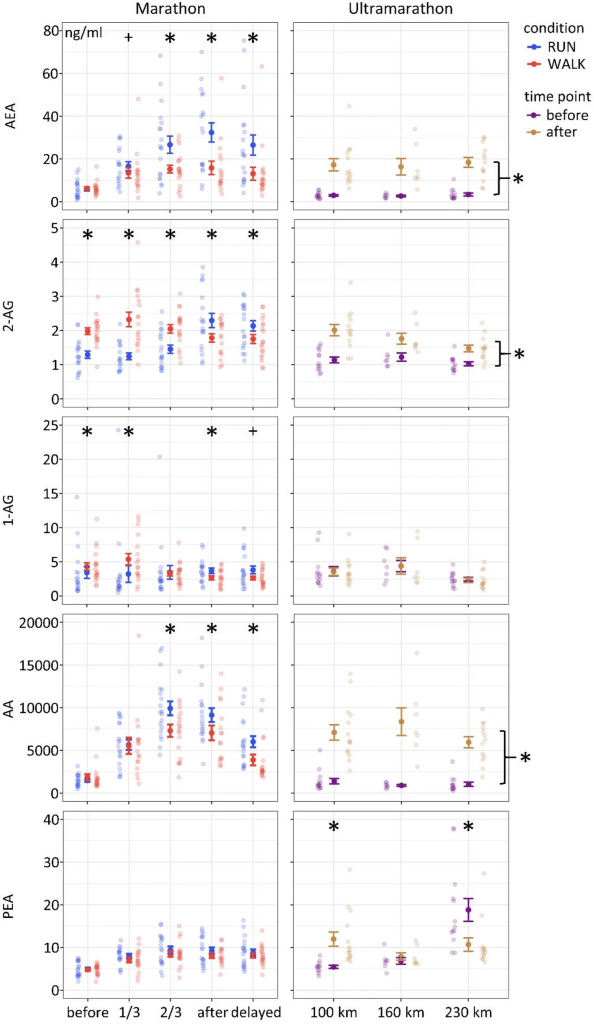
The study followed endocannabinoid dynamics during marathon and ultramarathon running. The authors measured anandamide (AEA), 2-AG, 1-AG, arachidonic acid (AA) and PEA in blood during prolonged endurance exercise. In the marathon arm, 19 trained runners completed both a marathon and a time-matched walking session, with repeated blood sampling throughout. A second cohort included 36 runners completing ultramarathons of 100, 160 or 230 km.
The obvious takeaway is that prolonged running changes endocannabinoid signaling.
That is interesting, but it is not the part of the paper that caught my attention most.
What caught my attention was the arachidonic acid curve.
Three arachidonate-related signals with different kinetics
AEA rose progressively during the marathon and was already higher during running than walking from 14 km onward.
Free AA followed a somewhat different trajectory. There was no clear early difference between running and walking, but from around 28 km onward plasma AA became significantly higher during the marathon.
2-AG was different again. Its running-associated increase emerged later, toward the end of the marathon and into recovery.
So this is not simply a case of “exercise increases endocannabinoids.”
There are several arachidonate-related signals appearing with different temporal kinetics during the same prolonged physiological challenge.
That immediately makes me think about lipid turnover.
AEA and 2-AG are produced through different enzymatic pathways, which the authors themselves point out when discussing their different time courses.
Free AA adds another layer.
Why the arachidonic acid curve matters
The authors describe endocannabinoids as being synthesized on demand from arachidonic-acid-containing membrane phospholipids in tissues including skeletal muscle, vasculature and brain.
They also point out that the available arachidonate reservoir appears sufficient to support endocannabinoid synthesis for more than 24 hours of endurance running.
That raises a basic question that I do not think we understand very well:
What determines how much arachidonate an individual mobilizes during a prolonged physiological challenge?
The study did not measure phospholipase activity, so we cannot say from these data that the plasma AA rise was caused by PLA2-mediated membrane hydrolysis.
There are other possible contributors. AEA degradation through FAAH produces AA. 2-AG degradation through MAGL also produces AA. Circulating AA may therefore reflect several processes happening simultaneously.
Still, the overall picture is consistent with substantial arachidonate turnover during prolonged running.
And that is where I think this paper becomes much more interesting than another study of the runner’s high.
Endurance exercise as a membrane-remodeling challenge
We normally describe endurance exercise through energy metabolism.
Glycogen is consumed. Fat oxidation rises. Lactate changes. Oxygen consumption increases. Muscle fibers experience mechanical and metabolic stress.
But the new data suggest that another process is occurring at the same time.
Large amounts of arachidonate-related lipid signaling are being mobilized.
Arachidonic acid is heavily represented in membrane phospholipids. Once released, it can enter multiple signaling pathways. Lipids subsequently have to be metabolized, recycled or reincorporated into membranes.
So repeated endurance exercise may involve repeated cycles of:
membrane lipid mobilization
→ signaling
→ metabolism
→ reacylation
→ membrane remodeling
The Siebers study does not demonstrate that entire sequence.
But it gives us a remarkably clear view of the mobilization side.
That makes the composition of the membrane before exercise suddenly much more interesting.
The study measured the response, but not the starting state
People differ substantially in their fatty-acid profiles.
Those profiles are not simply a reflection of what someone ate yesterday.
They emerge from the interaction between dietary fatty-acid supply, absorption, endogenous synthesis, elongation and desaturation, genetics, metabolic state, tissue turnover and previous physiological history.
This is why I find RBC fatty-acid profiling so useful.
It gives us a relatively stable readout of longer-term membrane fatty-acid status.
I have started thinking of it as a biochemical receipt.
Not a perfect readout of every tissue in the body, and certainly not a direct measure of function, but a record of where fatty-acid biology has ended up after diet, genetics and metabolism have interacted over time.
The new marathon study gives us the other side of the equation.
It shows what happens when that biological state is challenged.
Why RBC fatty acid profiles could add the missing layer
The blood samples in the marathon study were collected in EDTA tubes before plasma was separated for endocannabinoid analysis.
If erythrocytes, packed cells or suitable residual whole blood from those samples are still stored, a secondary analysis could be extremely informative.
I would start with one simple question:
Does baseline RBC arachidonic acid predict the plasma AA response during the marathon?
That is probably the cleanest first test.
The RBC measurement would represent the slower membrane fatty-acid state.
The plasma AA curve would represent the acute arachidonate response to prolonged exercise.
If those two are related, we would have evidence that a relatively stable fatty-acid phenotype predicts the magnitude of a rapid physiological lipid response.
Only after that would I move downstream and ask whether the same baseline fatty-acid profile also relates to the AEA and 2-AG response curves.
The walking condition makes this unusually valuable
One of the strongest features of the study is that the same marathon runners also completed a time-matched walking condition.
Blood sampling occurred at corresponding time points in both conditions. The external duration was similar, but the physiological load was very different.
That means the most interesting analysis might not even be absolute AA concentrations.
It could be the exercise-specific difference:
RBC fatty-acid state
→ RUN minus WALK arachidonate response
If baseline membrane composition predicted the difference between the running and walking responses, that would be much harder to explain as a simple association between fatty-acid status and circulating lipids.
It would suggest that the starting fatty-acid state is related to how the system responds when demand increases.
What a positive secondary analysis would mean
A positive result would not prove that RBC membranes themselves were supplying the AA appearing in plasma.
RBC fatty acids would be acting as a surrogate for broader fatty-acid status.
It would also not prove that membrane AA causally determines endocannabinoid signaling.
But it would establish something that, to my knowledge, we do not currently have in human exercise physiology:
a relationship between a relatively stable membrane fatty-acid phenotype and a dynamic arachidonate response to prolonged physiological demand.
That is an important distinction.
The fatty-acid profile tells us something about where the system starts.
The exercise challenge tells us what that state does under stress.
The AA, AEA and 2-AG curves tell us how parts of the lipid-signaling system respond over time.
Those are different biological layers.
Measuring them together could be much more informative than measuring any one of them in isolation.
The next experiment: fatty acid status and ECS challenge-response physiology
If baseline RBC AA predicted the magnitude or kinetics of the marathon AA response, the obvious next step would be intervention.
Measure the fatty-acid profile.
Perform a standardized endurance challenge with repeated AA, AEA and 2-AG sampling.
Alter fatty-acid status over a period of weeks or months.
Then repeat exactly the same challenge.
The important question would no longer be whether fatty-acid status correlates with the response.
It would be whether changing fatty-acid status changes the response.
That would start moving the question from association toward causality.
The broader implication
This study made me think differently about what endurance exercise actually represents biologically.
A long run is clearly an energetic challenge.
But it also appears to be a strong arachidonate-mobilizing challenge.
And if repeated endurance exercise repeatedly mobilizes membrane-derived lipid substrates, then recovery is not just about restoring glycogen and repairing muscle.
The lipid environment in which membranes are rebuilt may matter too.
That immediately brings diet, genetics, fatty-acid metabolism, exercise and the endocannabinoid system into the same biological conversation.
The paper does not prove that these factors are connected in the way I am proposing here.
What it does is expose a very interesting missing variable.
We know a great deal about the downstream response.
We do not know what fatty-acid substrate state these runners entered the marathon with.
If the relevant samples are still sitting in a freezer, that may be worth finding out.
The question I would now ask
Does an individual’s membrane fatty-acid state help determine how strongly their arachidonate signaling system responds to endurance exercise?
The answer may already be partly accessible from samples that have been collected.
And if the answer is yes, it would open a much bigger discussion about fatty-acid status not simply as a nutritional biomarker, but as an upstream biological state variable in human adaptation.
Author’s note
After publication of this article, I contacted lead author Dr. Michael Siebers to ask whether stored blood material might allow this hypothesis to be explored. He agreed that fatty-acid profiling in relation to interindividual endocannabinoid responses would be interesting and is checking whether suitable material remains from the ultramarathon cohort.
Reference:
Siebers M, Huvermann D, Siebers C, et al. Endocannabinoid dynamics across marathon and ultramarathon running: evidence from two field studies. BMC Med. 2026;24(1):469. Published 2026 Sep 1. doi:10.1186/s12916-026-05186-z