
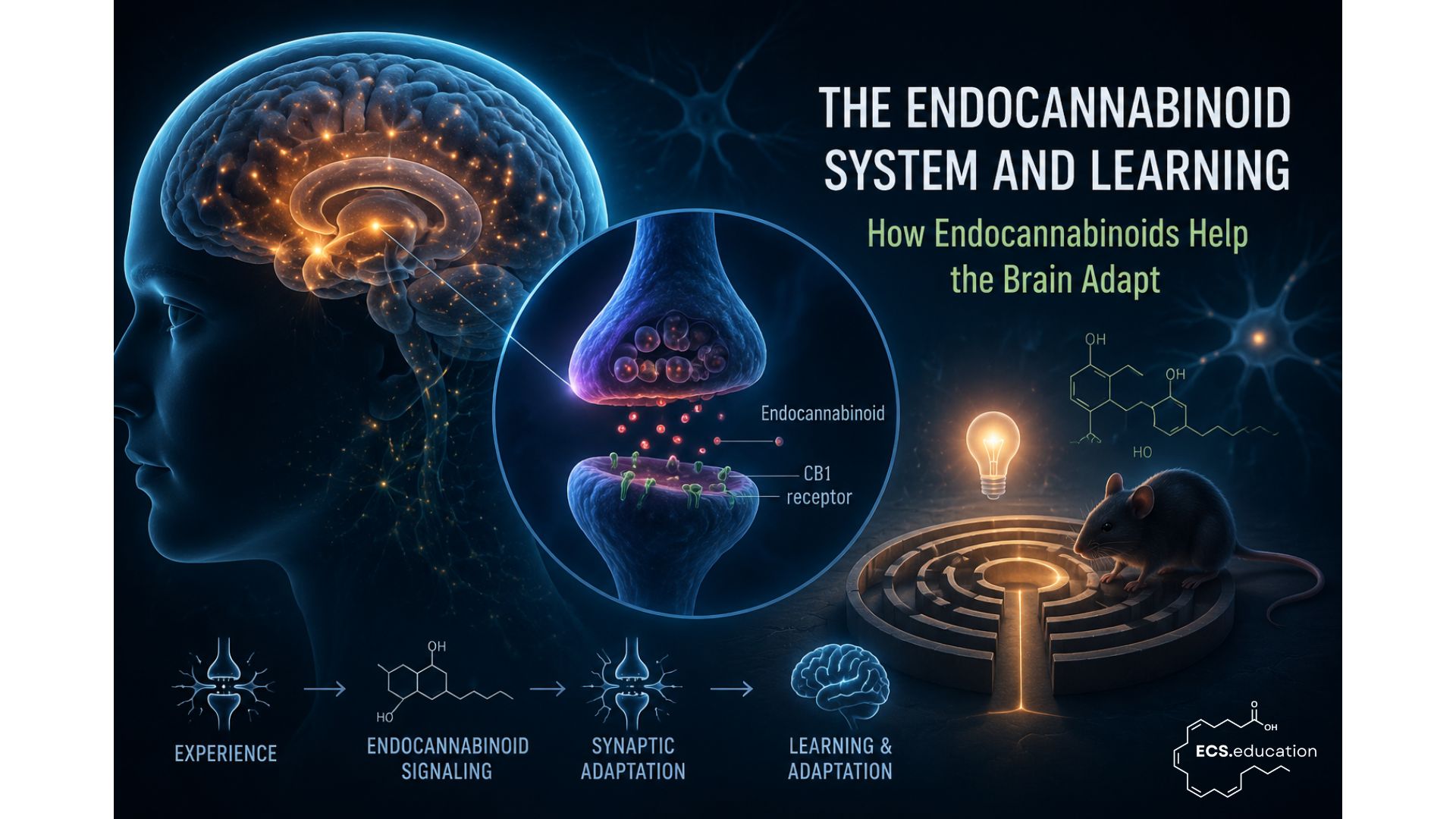
The Endocannabinoid System and the Biology of Learning: How Endocannabinoids Help the Brain Adapt
Why one-shot learning matters for survival
Imagine touching a hot surface for the first time. The experience lasts only a moment, but the lesson can last a lifetime. The brain does not need repeated exposure to understand that something matters. A single meaningful event can permanently alter future behaviour.
This ability, known as one-shot learning, is fundamental for survival. Organisms must continuously decide which experiences are important enough to change future behaviour and which can be ignored.
For decades, neuroscience has focused on classical mechanisms of learning involving repeated stimulation and gradual strengthening of neural connections. However, many real-world experiences do not happen through repetition. Sometimes adaptation must occur rapidly.
A recent study published in Nature Neuroscience provides important evidence that the endocannabinoid system (ECS) is directly involved in this rapid form of learning. The researchers demonstrated that a specific form of endocannabinoid-mediated synaptic plasticity enables mice to form lasting memories after a single brief experience (Piette et al., 2026).
The findings add another important piece to a growing understanding of the ECS: it is not simply a system involved in the effects of cannabis. It is an endogenous physiological signalling system that regulates adaptation across the body and brain.
New research reveals a role for endocannabinoids in learning
The brain contains billions of neurons communicating through trillions of synaptic connections. Learning occurs when some of these connections are modified, allowing future responses to become faster, more appropriate, or more efficient.
This process is called synaptic plasticity.
A simplified view has traditionally been that stronger neural activity leads to stronger connections. However, the brain needs more sophisticated mechanisms because not every experience deserves a permanent change.
The ECS appears to contribute to this decision-making process.
Endocannabinoids are lipid-derived signalling molecules produced by the body itself. These molecules function as local regulatory signals, with 2-arachidonoylglycerol (2-AG) acting as one of the most abundant and important endogenous CB1 ligands in the brain. Unlike classical neurotransmitters that are often released from one neuron to communicate with another, endocannabinoids frequently act as local feedback signals. They are produced when needed and help regulate the strength and timing of neuronal communication (Piomelli, 2003; Lu and Mackie, 2016).
In other words, the ECS does not simply transmit information. It helps determine how strongly biological systems should respond to information.
CB1 is more than a cannabinoid receptor
The cannabinoid receptor CB1 is often introduced as the receptor activated by THC and other cannabinoids. While this is pharmacologically correct, it represents only a small part of the receptor’s physiological role.
CB1 evolved to respond primarily to endogenous lipid signals produced by the body.
The new Nature Neuroscience study investigated endocannabinoid-mediated long-term potentiation (eCB-LTP) in the striatum, a brain region involved in action selection, habit formation, and behavioural adaptation.
Using a newly developed behavioural paradigm in mice, the researchers showed that a single brief encounter with an aversive stimulus could trigger a lasting behavioural change. This learning process required CB1-dependent plasticity mechanisms in corticostriatal circuits. When CB1 signalling or the molecular pathways required for eCB-LTP were disrupted, one-shot learning was impaired (Piette et al., 2026).
The significance is not simply that “cannabinoid receptors affect memory.”
The deeper implication is that endocannabinoid signalling helps convert experience into adaptation.
This raises a broader question that remains largely unanswered in medicine: how do we determine the functional state of CB1 signalling in an individual?
The endocannabinoid system as a regulator of adaptation
Biological systems must constantly balance stability and change.
Too little adaptation and organisms fail to respond appropriately to new challenges.
Too much adaptation and biological systems become unstable.
The ECS is uniquely positioned to regulate this balance because it integrates multiple forms of information:
- neuronal activity
- metabolic state
- stress signals
- energy availability
- environmental demands
This is why CB1 is better understood as an adaptive regulator rather than simply a receptor linked to cannabis pharmacology.
A useful analogy is a vehicle’s suspension system. The suspension does not create movement, and it does not determine where the vehicle travels. Instead, it continuously adjusts how the vehicle responds to the road.
Similarly, CB1 does not create learning by itself. Rather, it helps determine how strongly neural circuits adapt when meaningful experiences occur.
Why biological context shapes ECS function
One of the most important implications of ECS research is that receptor function cannot be separated from the biological environment in which it operates.
The endocannabinoids that activate CB1 are derived from membrane lipids. The availability and composition of these lipid substrates influence the cellular environment in which ECS signalling occurs, supporting the concept of a substrate-driven ECS model (Mechoulam and Parker, 2013).
This highlights a broader principle of systems biology:
A signalling pathway is not an isolated switch. Its behaviour depends on the cellular context surrounding it.
The same receptor can function differently depending on:
- membrane composition
- metabolic state
- inflammation
- stress exposure
- previous signalling history
This is why factors such as dietary lipid composition and metabolic state can influence ECS function.
This may help explain why individuals can respond very differently to cannabinoid-based interventions despite receiving similar compounds and doses.
The receptor is the same. The biological context is not.
Beyond cannabis: understanding the true purpose of the ECS
The existence of cannabis has shaped much of the public and medical discussion around the ECS. However, the evolutionary relationship is the opposite.
Cannabis does not explain why CB1 exists.
The ECS existed because biology required a system capable of regulating adaptation long before humans discovered cannabis.
The discovery that endocannabinoids support one-shot learning provides another example of this broader physiological role. The ECS participates in fundamental processes through which organisms learn, adapt, and respond to changing environments, including the physiological adaptations triggered by exercise and metabolic challenges.
Exercise provides another example of this principle, activating adaptive biological pathways involving the ECS and other regulatory systems.
The future of ECS research may therefore depend less on asking:
“What effects do cannabinoids produce?”
and more on asking:
“What biological state allows the ECS to function optimally?”
This shift also highlights why ECS education in healthcare remains essential.
Understanding the ECS as a regulator of adaptation opens a much larger scientific landscape, connecting neuroscience, metabolism, lifestyle, and precision medicine.
At its core, life depends on the ability to adapt. Learning is one of the most remarkable examples of this principle: every memory represents a biological decision that an experience was meaningful enough to change future behaviour. The discovery that endocannabinoids help drive one-shot learning provides another reminder that the ECS is not a cannabis system. It is one of biology’s fundamental mechanisms for converting experience into adaptive responses.
References
Lu, H.C., & Mackie, K. (2016). An introduction to the endogenous cannabinoid system. Biological Psychiatry, 79(7), 516–525.
Mechoulam, R., & Parker, L.A. (2013). The endocannabinoid system and the brain. Annual Review of Psychology, 64, 21–47.
Piomelli, D. (2003). The molecular logic of endocannabinoid signalling. Nature Reviews Neuroscience, 4, 873–884.
Piette, C., Hubert, A., Perez, S., Peixoto, J., Gervasi, N., Berry, H., Touboul, J., & Venance, L. (2026). Striatal endocannabinoids drive one-shot learning. Nature Neuroscience. doi:10.1038/s41593-026-02392-z.