
Introduction: The Evolution of an Idea
When I first began my career in molecular pharmacology, the endocannabinoid system (ECS) quickly became a source of intrigue. Here was a unique receptor system, defined by its enigmatic lipid messengers and central role in brain physiology. Like many, I was trained to see 2-arachidonoylglycerol (2-AG) as a classic retrograde messenger, acting through G protein-coupled receptors (GPCRs), and to view intracellular signaling as a tightly choreographed dance of proteins and second messengers. The focus was naturally on GPCRs, not as much on their ligands. Yet, as science so often does, recent discoveries have upended these assumptions and revealed several new mechanisms of action for how 2-AG is able to shape the neural landscape.
The Old Model: GPCRs at the Helm
The ECS is most commonly interpreted through the lens of GPCRs, where CB1 and CB2 receptors act as the main conduits for endocannabinoid effects. In this framework, 2-AG was the key that fit the lock, modulating synaptic transmission and plasticity through well-defined receptor-mediated pathways. This model was elegant, but as we now see, quite incomplete.
Expanding the Landscape of Endogenous 2-AG Signaling
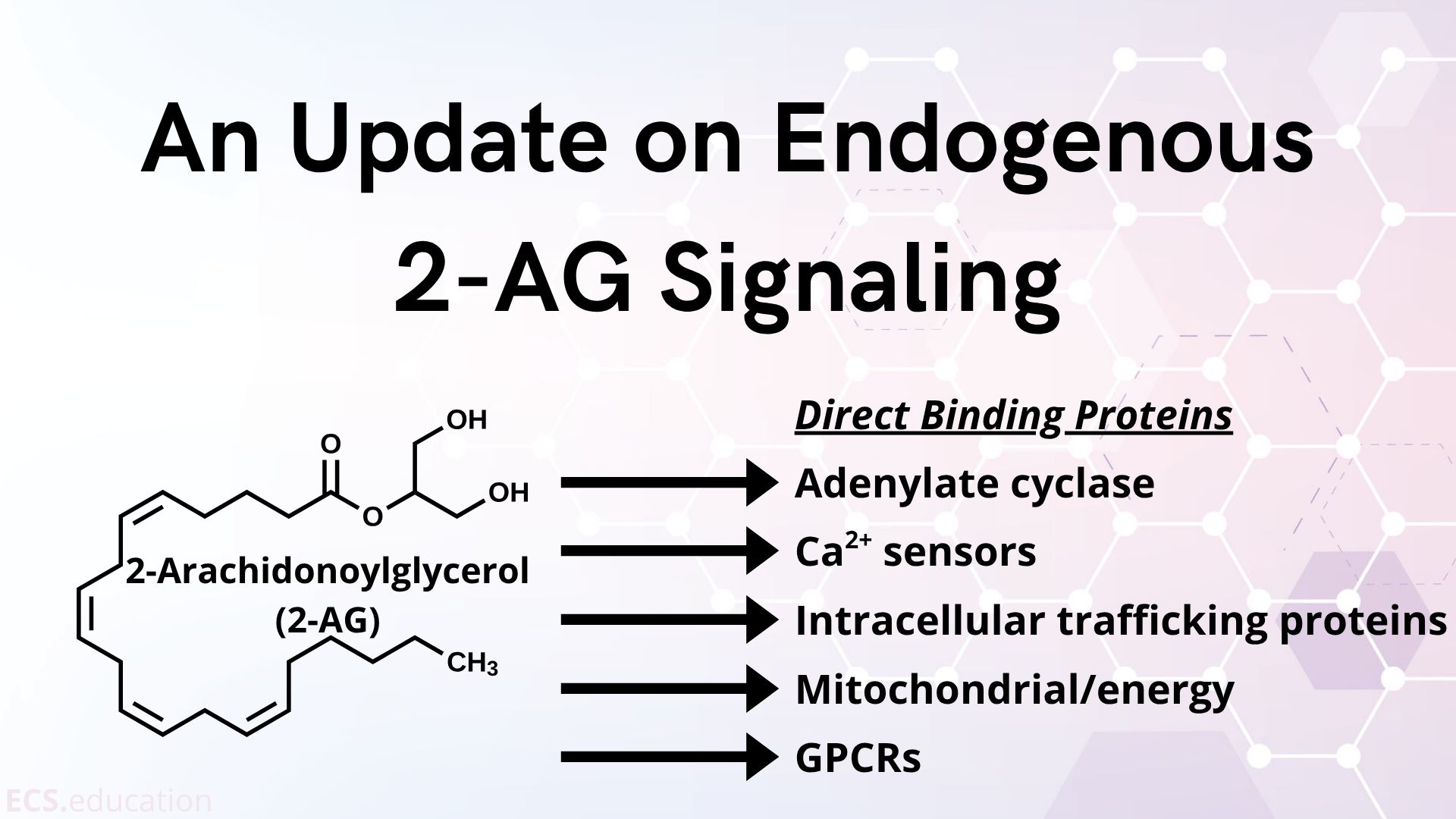
Earlier this year, I wrote about a revolutionary finding: adenylyl cyclases (ACs), long considered mere effectors for GPCRs, are themselves sensitive to lipid messengers like 2-AG. This discovery revealed that 2-AG can directly modulate cAMP levels in neurons, bypassing receptors altogether. It was a moment of genuine scientific humility, making it clear that the ECS is not just a system of locks and keys, but a nuanced language where lipids can speak directly to the machinery of cellular signaling.
Just as I was absorbing this new paradigm, a new layer of complexity emerged. Recent chemoproteomic research by Shanbhag et al., (2025) show us that 2-AG and related monoacylglycerols (MAGs) can bind directly to neuronal calcium sensor proteins, such as Hippocalcin. For someone steeped in the dogma of receptor-mediated signaling, the idea that 2-AG could influence calcium dynamics—the heartbeat of neuronal communication—without ever engaging a GPCR is both exhilarating and a tad bit unsettling.
The Bigger Picture: 2-AG as a Master Integrator
These discoveries have fundamentally changed how I view the ECS. No longer is 2-AG simply a retrograde messenger and GPCR ligand. It is a master integrator, capable of:
- Directly modulating cAMP synthesis via adenylyl cyclases, independently of GPCRs.
- Directly influencing calcium signaling by binding to calcium sensor proteins, shaping synaptic plasticity, learning, and memory.
This dual capacity positions 2-AG as a central hub, integrating metabolic, synaptic, and environmental cues—far beyond the boundaries of the classic receptor-centric model.
Why Calcium and cAMP Matter
Calcium ions are the universal currency of neural plasticity, learning, and memory. By modulating calcium sensor proteins directly, 2-AG can potentially fine-tune the strength and timing of synaptic transmission, influence neuroplasticity, and orchestrate gene expression. Meanwhile, cAMP is a key regulator of metabolic and neurotransmitter signaling. The realization that 2-AG can directly regulate both cAMP and calcium signaling—fully independent of GPCRs—fundamentally changes the narrative and tells us that endocannabinoid pharmacology is much more complex than previously considered.
The Secret Life of Vesicles: A Personal Connection
Reflecting on my own doctoral work, which was about unraveling how GPR30/GPER1 orchestrates receptor trafficking and cAMP signaling through G protein-independent routes, I’m struck by the continuity in scientific discovery. My fascination with the “hidden wiring” of membrane trafficking finds new resonance in the recent chemoproteomic data showing that MAGs, including 2-AG, bind directly to Rab GTPases—the master regulators of vesicle traffic.
The study revealed robust enrichment of several Rab proteins (Rab-10, Rab-11B, Rab-14, Rab-5C, Rab-2A, Rab-3A, and others) among MAG-binding partners in neural tissues. These Rabs coordinate a spectrum of trafficking routes, from recycling endosomes to secretory pathways. The implication is profound: 2-AG and related MAGs may act as direct molecular switches for the vesicle trafficking machinery itself, influencing not just synaptic vesicle release, but the entire landscape of neuronal membrane dynamics.
As someone who has spent years tracing the routes of receptors and vesicles, the prospect that 2-AG might serve as a direct modulator of Rab GTPases is both humbling and inspiring. It challenges us to think of lipid messengers as active participants in the dance of cellular organization, not just as passive bystanders.
Expanding the Landscape: Diversity, Selectivity, and Metabolic Integration
Recent supplementary data from Shanbhag et al. provide compelling evidence that 2-AG and related MAGs bind a broad and diverse array of proteins in the brain—not only neuronal calcium sensors and Rab GTPases, but also mitochondrial import receptors (e.g., TOM22), ATP synthase subunits, synaptic vesicle proteins, and cytoskeletal elements. Importantly, some of these MAG-protein interactions are highly selective (such as with Hippocalcin and TOM22), while others appear to act as more general lipid sensors, highlighting both the specificity and the breadth of this signaling mechanism.
The enrichment of mitochondrial proteins among MAG targets hints at a direct link between lipid signaling and neuronal energy metabolism. Meanwhile, the robust identification of multiple Rab GTPases across both membrane and soluble fractions underscores the emerging view of 2-AG as a direct modulator of vesicle trafficking and synaptic plasticity.
Interestingly, the MAG-binding proteome varies by cell type: while neurons are enriched for calcium sensors and trafficking machinery, immune cells show more metabolic and stress response proteins, suggesting potential roles for MAG signaling in neuroimmune crosstalk.
Structural modeling, using computer simulations, further support these findings by revealing well-defined hydrophobic binding pockets for MAGs in key protein targets, with energetically favorable interactions. This provides a mechanistic basis for how these lipid messengers can directly modulate protein function.
Technical Robustness of the Chemoproteomic Approach
The credibility of these findings is reinforced by the technical rigor of the chemoproteomic strategy: the researchers employed extensive controls, quantitative labeling, and stringent criteria for protein enrichment, ensuring that only high-confidence MAG-protein interactions were reported. This robust methodology strengthens the reliability of the conclusions drawn from the data.
Table: The New Direct Pathways of 2-AG
| Messenger | Classic Pathway | New Direct Pathway | Key Effect | Reference |
|---|---|---|---|---|
| cAMP | GPCR → AC | 2-AG → AC (lipid sensing) | Metabolic & neurotransmitter regulation | Landau et al., 2024 |
| Ca²⁺ | GPCR → Ca²⁺ channels | 2-AG → Calcium sensors | Synaptic plasticity, learning, memory | Shanbhag et al., 2025 |
| Vesicle Trafficking | GPCR/Protein interactions | 2-AG → Rab GTPases | Synaptic vesicle dynamics, receptor recycling | Shanbhag et al., 2025 |
| Mitochondrial/Energy | Indirect signaling | 2-AG → Mitochondrial proteins | Energy metabolism, synaptic integration | Shanbhag et al., 2025 |
Looking Ahead: Unanswered Questions
- How do fluctuations in 2-AG levels, driven by diet or stress, impact these newly discovered pathways?
- Can we harness this knowledge to develop new therapies for neurological, metabolic, or even neuroimmune diseases?
- What other protein partners of 2-AG are waiting to be discovered?
Conclusion: The ECS, Reimagined
The story of 2-AG is no longer confined to the synapse or the GPCR. It is a multifaceted lipid messenger capable of orchestrating cAMP, Ca²⁺, vesicle trafficking, and perhaps other cellular signals fully independent of its interactions with GPCRs. As research continues to map this new signaling landscape, one thing is starting to become clear: our understanding of the ECS is evolving.
As both a researcher and an educator, I am eager to see where this expanding universe of endocannabinoid signaling will take us. The ECS, and especially 2-AG, is proving to be far more versatile and influential than we ever imagined. It is a reminder that in science, as in life, the most exciting discoveries often come when we are willing to look beyond established boundaries and embrace the unknown.
Comment
Comments are closed.