
This open letter was first reported by CannaReporter on September 2, 2026. The full scientific statement and current list of signatories are published here on ECS.education.
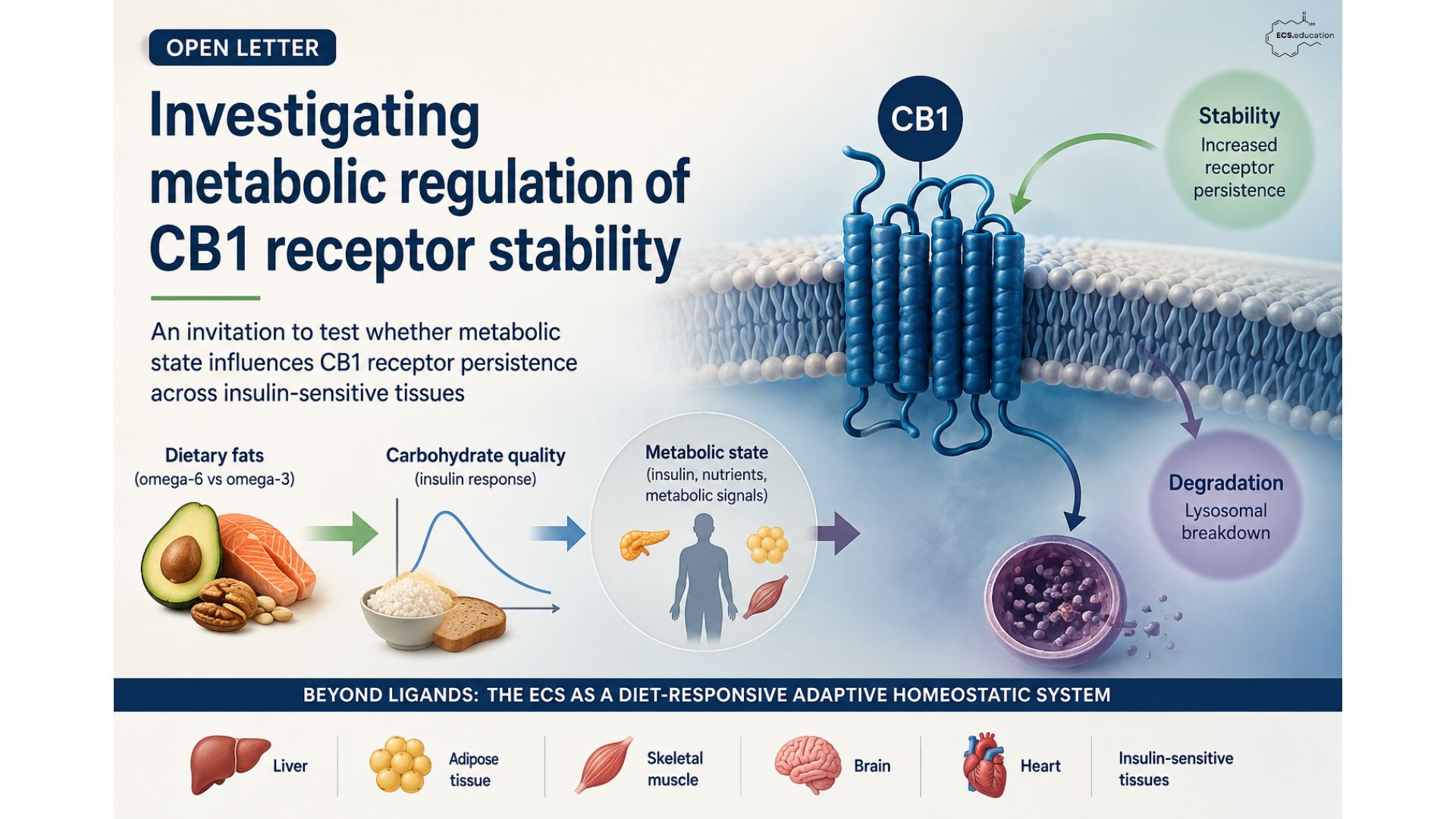
Investigating metabolic regulation of CB1 receptor stability
An open invitation to test whether metabolic state influences CB1 receptor persistence across insulin-sensitive tissues
The endocannabinoid system (ECS) is increasingly recognized as an important regulator of energy balance, lipid metabolism, glucose regulation, reward, stress adaptation and tissue homeostasis.
Yet one fundamental question remains largely unexplored:
Does metabolic state regulate CB1 receptor stability across insulin-sensitive tissues?
More specifically, can metabolic signals alter how long CB1 receptors persist at the protein level by changing receptor trafficking and degradation?
Recent findings provide a compelling rationale for asking this question.
Liu et al. (2026) demonstrated that insulin increases hepatic CB1 receptor protein through an ERK-dependent mechanism that suppresses lysosomal degradation. Importantly, the effect did not require increased CNR1 transcription.
In other words, insulin did not simply tell the cell to make more CB1. It changed what happened to CB1 receptors that were already being produced.
Separately, Bærentzen et al. (2024) found that just 12 days of excessive sucrose exposure increased hippocampal CB1 binding in Göttingen minipigs, alongside changes in synaptic density markers and glutamatergic signalling.
These observations arise from different tissues and experimental models, and they do not establish a common mechanism. But together they raise a testable possibility:
Could metabolic state regulate CB1 abundance and functional availability beyond transcriptional control?
If the insulin-dependent mechanism identified in the liver also operates in other insulin-sensitive tissues, the implications could extend well beyond hepatic CB1 biology.
A two-layer model of metabolic ECS regulation
The functional state of the ECS may be shaped by at least two complementary dimensions.
1. Substrate regulation
Dietary fatty-acid composition can influence cellular membrane lipid composition and the availability of lipid substrates from which endogenous signalling molecules are generated.
For the ECS, this is particularly relevant because its principal endogenous ligands are lipid-derived.
2. Receptor regulation
Metabolic signals such as insulin may also influence the abundance, trafficking, stability and degradation of CB1 receptors themselves.
These two layers are mechanistically distinct.
One affects the substrates available for signalling.
The other may affect the receptors available to receive that signalling.
Together, they could help determine the functional state of CB1 signalling within a tissue.
This leads to a broader hypothesis:
The ECS may need to be understood not only as a receptor system activated by endogenous and exogenous cannabinoids, but as a diet-responsive adaptive homeostatic system whose functional state is shaped by both substrate availability and metabolic signalling.
This hypothesis remains to be tested.
Why this question matters
Much of endocannabinoid research has understandably developed through the lens of cannabinoid pharmacology: ligands, receptors, enzymes, agonists, antagonists and the physiological consequences of receptor activation.
But the ECS does not operate in isolation.
It is embedded within the metabolic machinery of the cell.
CB1 signalling intersects with insulin action, energy storage, glucose handling, lipid metabolism, mitochondrial function, reward circuitry and adaptive responses to changing physiological conditions.
That makes receptor abundance itself an important variable.
A cell exposed to the same concentration of an endogenous or exogenous CB1 agonist may respond differently depending on how much functional receptor is available, where those receptors are located and how effectively they couple to downstream signalling pathways.
If insulin or other metabolic signals regulate CB1 stability across multiple tissues, then metabolic state could alter the biological response to a given cannabinoid signal before the ligand even reaches the receptor.
This could have implications for our understanding of:
- obesity and insulin resistance
- metabolic flexibility
- energy storage and substrate utilization
- reward and feeding behaviour
- tissue-specific ECS dysregulation
- interindividual variation in cannabinoid responses
- the physiological consequences of changing dietary environments
It may also help explain why describing the ECS simply in terms of “high” or “low” endocannabinoid tone can be insufficient.
Ligand availability is only one part of a receptor signalling system.
Receptor availability matters too.
The experimental question
We therefore invite researchers to investigate:
Does metabolic state regulate CB1 receptor stability across insulin-sensitive tissues through altered receptor trafficking and degradation pathways?
Several questions follow directly.
Does insulin suppress CB1 degradation in adipocytes?
Does the same mechanism occur in skeletal muscle?
Is it present in cardiac tissue?
Does it operate in metabolically responsive regions of the brain?
Does insulin resistance alter the relationship?
Do repeated postprandial insulin excursions produce different effects from acute insulin exposure?
Are CB1 internalization, recycling and lysosomal sorting altered?
And critically:
Are these changes sufficient to modify functional CB1 signalling in vivo?
These are experimentally tractable questions.
They can be addressed using established approaches for receptor trafficking, surface-expression assays, internalization and recycling studies, lysosomal inhibition, receptor turnover measurements, signalling assays and tissue-specific in-vivo models.
What this open letter does, and does not, propose
We are not proposing that CB1 dysregulation explains all metabolic disease.
We are not claiming that insulin-mediated regulation of CB1 has already been demonstrated across insulin-sensitive tissues.
We are not assuming that increased or decreased CB1 signalling is inherently beneficial or harmful.
CB1 physiology is highly dependent on tissue, cellular context, timing and physiological state.
Our proposal is narrower:
There is sufficient evidence to justify directly testing whether metabolic regulation of CB1 protein stability represents a broader principle of ECS biology.
If the hypothesis is supported, it could expand our understanding of how nutritional and metabolic environments shape ECS function.
If it is not supported, establishing the tissue-specific limits of this mechanism would still provide valuable information.
Either outcome advances the field.
A broader view of the ECS
The implications extend beyond receptor trafficking.
If dietary fatty acids influence the substrate environment from which endocannabinoid signalling emerges, while metabolic hormones simultaneously regulate the receptors through which those signals act, then nutrition may interact with the ECS at multiple mechanistic levels.
This would place the ECS within a much broader biological framework.
Rather than viewing it primarily as the system upon which cannabis acts, we may increasingly need to ask how it participates in the body’s continuous adaptation to nutritional state, metabolic demand and environmental change.
Cannabinoids would remain important pharmacological tools and therapeutic agents.
But cannabis pharmacology would represent only one entry point into a much larger physiological system.
Understanding that system requires understanding not only what activates CB1, but also what determines the state of CB1 itself.
Appeal to researchers
We invite researchers working in endocannabinoid biology, molecular pharmacology, metabolic physiology, neurobiology, receptor trafficking and translational medicine to investigate this question.
The aim of this initiative is not to promote a predetermined conclusion.
It is to identify a mechanistically plausible, experimentally accessible and potentially important gap in our understanding of CB1 biology.
We particularly welcome experimental data capable of confirming, refining or falsifying the hypothesis.
Does metabolic state regulate CB1 receptor stability across insulin-sensitive tissues?
We believe the question is worth answering.
Signatories
Stefan Broselid, Ph.D.
M.Sc. Biomedical Sciences
Founder, ECS.education
Linderöd, Sweden
Paul Clayton, Ph.D.
B.Sc. (Hons) Pharmacology
Institute of Interdisciplinary Medicine
St. Louis, USA
Anthony Ferrari, Ph.D.
Analytical Chemistry
Sym Sciences
Tampa, USA
Callie Seaman, Ph.D.
B.Sc. (Hons) Biomedical Sciences
Sunnyside Consultants
Sheffield, UK
Shabnam Sarshar, Ph.D.
Pharmaceutical Biology and Phytochemistry
Department of Pharmacy, University of Münster
Münster, Germany
Dinesh Thapa, Ph.D.
Biomedical Science
M.Sc. Pharmacology; Bachelor of Pharmacy
Curtin Medical School, Curtin University
Perth, Australia
Signatory statement
Co-signatories support the importance of investigating this scientific question and the value of rigorous experimental evaluation.
Their signatures do not indicate that the proposed mechanism has been established, nor do they imply endorsement of any conclusion beyond the need for further investigation.
References
- Liu SY, Ting CH, Hwang GS, et al. Insulin increases expression of cannabinoid receptor 1 by suppressing lysosomal degradation via ERK signaling pathway. Int J Med Sci. 2026;23(6):2027–2038. Published May 1, 2026. doi:10.7150/ijms.126308.
- Bærentzen SL, Thomsen MB, Alstrup AK, et al. Excessive sucrose consumption reduces synaptic density and increases cannabinoid receptors in Göttingen minipigs. Neuropharmacology. 2024;256:110018. doi:10.1016/j.neuropharm.2024.110018.
- Avalos B, Olmos M, Wood CP, et al. Δ9-Tetrahydrocannabinol and cannabis extracts differentially improve adipoinsular dysfunction in diet-induced obesity. J Physiol. Published online May 11, 2026. doi:10.1113/JP290431.
- Katona I, Sperlágh B, Sík A, et al. Presynaptically located CB1 cannabinoid receptors regulate GABA release from axon terminals of specific hippocampal interneurons. J Neurosci. 1999;19(11):4544–4558.
- Nagappan A, Shin J, Jung MH. Role of cannabinoid receptor type 1 in insulin resistance and its biological implications. Int J Mol Sci. 2019;20(9):2109. doi:10.3390/ijms20092109.
- Liu J, Zhou L, Xiong K, et al. Hepatic cannabinoid receptor-1 mediates diet-induced insulin resistance via inhibition of insulin signaling and clearance in mice. Gastroenterology. 2012;142(5):1218–1228.e1. doi:10.1053/j.gastro.2012.01.032.
- Nogueiras R, Rohner-Jeanrenaud F, Woods SC, Tschöp MH. The endocannabinoid system and the control of glucose homeostasis. J Neuroendocrinol. 2008;20(Suppl 1):147–151. doi:10.1111/j.1365-2826.2008.01692.x.
- Friuli M, Eramo B, Sepe C, Kiani M, Casolini P, Zuena AR. The endocannabinoid and paracannabinoid systems in natural reward processes: possible pharmacological targets? Physiol Behav. 2025;296:114929. doi:10.1016/j.physbeh.2025.114929.
- Tuulari JJ, Karlsson HK, Antikainen O, et al. Obesity risk is associated with altered cerebral glucose metabolism and decreased μ-opioid and CB1 receptor availability. Int J Obes (Lond). 2021;45(11):2414–2424. doi:10.1038/s41366-021-00996-y.
- Osei-Hyiaman D, DePetrillo M, Pacher P, et al. Endocannabinoid activation at hepatic CB1 receptors stimulates fatty acid synthesis and contributes to diet-induced obesity. J Clin Invest. 2005;115(5):1298–1305. doi:10.1172/JCI23057.