
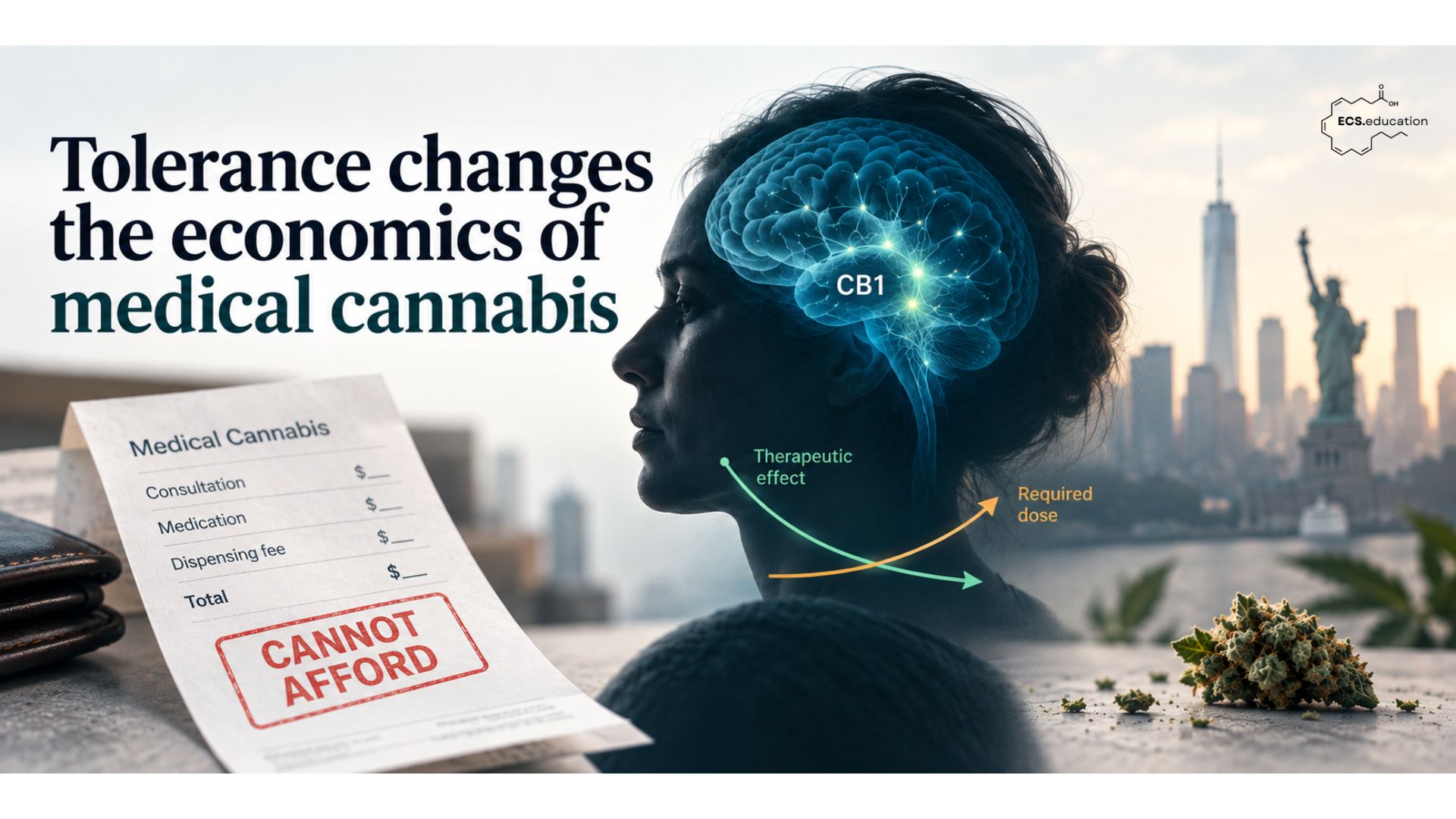
A pharmacological look at affordability, tolerance, CB1 adaptation and the very different THC exposure patterns emerging in medical cannabis.
A new study from the New York State Office of Cannabis Management reports that 49% of surveyed medical cannabis patients were unable to afford sufficient cannabis to adequately manage their symptoms. The finding comes from two statewide surveys conducted in 2023 and 2024, comprising 16,232 responses (Wilkins et al., 2026).
The obvious interpretation is that medical cannabis is too expensive. There is clearly evidence for this in the study: cost was one of the major barriers to remaining in the medical program, alongside declining geographical access to medical dispensaries (Wilkins et al., 2026).
But from a pharmacological perspective, the finding raises another question that deserves much more attention: what determines how much cannabis a patient requires to achieve symptom relief in the first place?
This matters because THC is not simply a product that patients consume in greater or smaller quantities. It is a CB1 receptor agonist, and sustained exposure can change the responsiveness of the biological system upon which its effects depend. If a patient requires progressively more THC to achieve a similar therapeutic effect, increasing treatment cost may reflect not only the price of cannabis, but also a changing pharmacodynamic requirement.
The New York study documents affordability and patterns of cannabis consumption, but it does not quantify longitudinal THC dose escalation or cannabinoid tolerance (Wilkins et al., 2026). That omission matters because dose requirement itself may be shaped by prior THC exposure.
Cannabis users already understand tolerance
Anyone familiar with cannabis knows that the same THC dose does not necessarily represent the same functional dose in different people. Relatively small THC doses can produce substantial effects in someone with little tolerance, whereas the same nominal exposure may produce much less effect in someone using high-THC cannabis every day.
In pharmacological terms, this is a familiar consequence of repeated receptor stimulation. In a controlled study, frequent cannabis users given identical intravenous THC doses showed attenuated psychotomimetic, perceptual, cognitive, anxiogenic and cortisol responses compared with less-exposed controls, despite similar experimental dosing. Importantly, tolerance was not uniform across every measured effect; the euphoric response was not significantly attenuated (D’Souza et al., 2008).
The clinically interesting question is therefore not only whether someone currently requires 5, 20 or 100 mg THC. It is whether that requirement has changed. A patient who has always required a relatively high dose and a patient who initially responded to a small dose but progressively required several-fold more THC represent very different pharmacological situations. The latter trajectory should make tolerance part of the clinical differential.
CB1 itself changes during chronic cannabis exposure
Human PET imaging provides direct evidence that chronic cannabis exposure alters CB1 receptor availability. Hirvonen and colleagues demonstrated regionally selective reductions in cerebral CB1 receptor availability in chronic daily cannabis smokers, with receptor availability returning toward control levels after approximately four weeks of monitored abstinence (Hirvonen et al., 2012).
D’Souza and colleagues subsequently reported approximately 15% lower CB1 receptor availability across most examined brain regions in cannabis-dependent men. After only two days of monitored abstinence, the between-group difference was no longer evident, with recovery continuing over the subsequent weeks (D’Souza et al., 2016).
PET receptor availability is not synonymous with every aspect of CB1 signaling or therapeutic sensitivity, so these values should not simply be transferred to individual medical cannabis patients. Nevertheless, the physiological principle is clear: chronic cannabis exposure can reduce cerebral CB1 receptor availability in humans, and at least part of that adaptation is reversible. Medical cannabis therefore acts on a biological target whose state depends on exposure history.
A medical prescribing pattern that increasingly resembles chronic cannabis use
This becomes particularly interesting when medical cannabis is considered as it is actually prescribed. Real-world registry data reveal two very different THC exposure patterns.
| Clinical prescribing pattern | Cohort | N | Prescribed THC exposure |
| Primarily oral, lower nominal THC | Australian longitudinal registry; oral medicinal cannabis | 3,961 | Median 10 mg/day; stable over >2 years |
| Primarily oral, lower nominal THC | German Pain e-Registry; dronabinol | 1,145 | Mean 15.8 ± 7.5 mg/day |
| Flower-heavy / mixed, higher nominal THC | UKMCR broad clinical cohort | 1,378 | 10 mg/day oil-only; 167.5 mg/day flower-only; 112 mg/day flower + oil |
| Flower-heavy / mixed, higher nominal THC | UKMCR insomnia | 124 | 20 mg/day at baseline → 120 mg/day at 18 months |
The prescribing contrast is substantial. In a large Australian registry of 3,961 patients treated with oral medicinal cannabis, the overall median THC dose was 10 mg/day and cannabinoid dosing remained broadly stable over two years (Vickery et al., 2022).
By comparison, a UK Medical Cannabis Registry analysis of 1,378 patients reported a median prescribed THC content of 10 mg/day for oil-only patients, 167.5 mg/day for dried-flower-only patients, and 112 mg/day for those receiving both flower and oil (Erridge et al., 2023). In an insomnia cohort, median prescribed THC increased from 20 mg/day at baseline to 120 mg/day at 18 months, with dried flower the most common treatment regimen (Aggarwal et al., 2025).
An earlier UK chronic-pain registry analysis supplemented its clinical outcomes dataset with subsequently extracted UK Medical Cannabis Registry prescription data. These prescription-linked data showed mean flower quantities of approximately 2.1 g/day among patients receiving oils plus flower and 2.2 g/day among flower-only patients (Harris et al., 2022).
At 20–25% THC, one gram of flower contains approximately 200–250 mg THC before accounting for incomplete delivery during vaporisation. That does not mean that 200–250 mg reaches systemic circulation. Oral and inhaled milligram doses are not pharmacokinetically equivalent, and product THC content should not be confused with absorbed exposure.
What matters is the exposure pattern that these prescriptions make possible. UK flower prescribing can involve sustained, frequently daily, high-THC exposure at quantities that overlap substantially with patterns associated with established cannabis use and tolerance.
This does not automatically mean the physiology is harmful
Chronic CB1 adaptation should not automatically be assumed to be physiologically harmful. Observational studies have repeatedly described the so-called cannabis paradox, in which habitual cannabis users show lower obesity prevalence or apparently favourable metabolic characteristics despite the orexigenic effects of acute THC exposure (Rajavashisth et al., 2012; Penner et al., 2013). Controlled metabolic studies are considerably more mixed and do not establish improved insulin sensitivity (Muniyappa et al., 2013; Bryan et al., 2025).
One possible contributor to this apparent paradox is adaptation itself. Chronic THC exposure does not simply reproduce the physiology of repeated acute THC doses; the organism adapts to persistent CB1 agonism.
This is precisely why measuring physiological state matters. The consequences of CB1 adaptation may differ between brain, adipose tissue, liver and other physiological domains, which is precisely why adaptive state should be measured rather than inferred from dose alone.
Repeated medical cannabis use can lose therapeutic efficiency
In 2025, Stith and colleagues analysed the first ten recorded cannabis treatment sessions from 16,395 medical cannabis patients, comprising 120,691 symptom-specific observations. Symptom relief declined progressively across repeated treatment sessions. Patients increased the amount of cannabis they consumed, but those increases did not fully offset the reduction in therapeutic response, with experienced cannabis users accounting for much of the effect (Stith et al., 2025).
This connects receptor pharmacology to a practical clinical and economic problem: repeated exposure can be accompanied by diminishing symptom relief, which can encourage greater consumption, which in turn increases treatment cost.
The study cannot tell us what proportion of the New York affordability problem is caused by tolerance. It does demonstrate that declining therapeutic efficiency accompanied by increasing consumption occurs in real-world medical cannabis use.
Tolerance turns pharmacology into pharmacoeconomics
Tolerance is usually discussed as a pharmacological issue: repeated exposure reduces responsiveness, so a larger dose is required to achieve the same effect. In medical cannabis, however, that adaptation also has an economic consequence.
The relationship is straightforward:
CB1 adaptation → lower responsiveness → higher dose requirement → greater monthly consumption → higher treatment cost
This is important because the financial burden of medical cannabis is not determined only by the price of the product. It is also determined by how much product is required to produce a useful clinical effect.
Consider two patients using the same THC-containing product for the same symptom. If one obtains adequate relief from a relatively low dose while the other requires several-fold more THC, their treatment costs differ even if the price per milligram is identical. If that difference has always existed, it may simply reflect interindividual variability in pharmacokinetics, disease biology or cannabinoid responsiveness.
The interpretation changes if the second patient initially responded to a much lower dose and progressively required more THC during sustained exposure. In that situation, part of the increased treatment cost may be downstream of acquired pharmacological tolerance.
This suggests that the relevant economic metric is not simply cost per gram of cannabis or even cost per milligram of THC, but something closer to cost per unit of therapeutic effect.
That distinction becomes especially important in a treatment model where the drug itself can alter the responsiveness of its primary receptor system over time. A cheaper product may reduce the immediate financial burden, but if declining cannabinoid responsiveness continues to increase the amount required for the same therapeutic response, the underlying pharmacoeconomic pressure remains.
Seen this way, tolerance is not merely an adverse pharmacological phenomenon occurring alongside treatment. It can become one of the variables that determines treatment affordability.
The clinically relevant question is therefore not only:
“How much does this patient’s cannabis cost?”
It is also:
“How much THC does this patient now require to obtain the same therapeutic effect, and how has that requirement changed since treatment began?”
Without that information, affordability analyses risk treating increased consumption as a fixed therapeutic need when, in some patients, it may partly reflect a changing response to chronic CB1 agonism.
We prescribe the exposure, but cannot yet measure the adaptation
This, to me, is the more important question raised by these datasets. UK medical cannabis has developed a prescribing model in which some patients receive chronic high-THC flower exposure at quantities that resemble established cannabis-use patterns.
Chronic adaptation should not automatically be equated with physiological harm. Reduced CB1 responsiveness could have different consequences across different tissues and functional domains. An adaptation that attenuates a desired CNS effect could contribute to loss of therapeutic efficacy, while altered CB1 signaling in metabolic tissues might produce a very different phenotype. The observational “cannabis paradox” is at least a reminder that chronic THC exposure cannot be understood simply as the repeated physiology of an acute dose.
At present, clinicians can measure what was prescribed, document symptom scores and adjust THC dose, but they generally cannot determine whether the patient’s underlying CB1-responsive physiology has moved from one functional state to another.
An exposure regime with a strong pharmacological basis for producing biological adaptation should ideally be accompanied by some way of measuring that adaptation.
The hypothesis is not that high-dose medical cannabis necessarily causes treatment failure. It is that chronic high-THC exposure can change CB1 responsiveness, and that this changing biological state may become an unmeasured determinant of both therapeutic efficacy and treatment cost.
This is the measurement problem we are trying to address at ECSre.store
PET imaging has established that CB1 receptor availability can change during chronic cannabis exposure and recover during abstinence, but PET is clearly unsuitable for routine longitudinal monitoring.
The translational challenge is therefore to determine whether changes in CB1-associated physiology might eventually be inferred using scalable, non-invasive measurements. This is one of the problems we are investigating at ECSre.store.
Our current work explores whether combinations of sleep EEG and sleep-stage-specific autonomic physiology can provide longitudinal physiological signatures that may be informative about changes in CB1-associated function. These biomarkers are not yet validated measurements of CB1 receptor availability. They should currently be regarded as inferred functional measures requiring prospective validation against established pharmacological and, ideally, PET-based reference methods.
The clinical question they are intended to address is concrete: can we distinguish a patient who needs more THC because the underlying condition remains undertreated from a patient who needs more THC because their response to THC has progressively changed?
Those patients may present with the same complaint – ‘my current dose is no longer enough’ – yet the rational therapeutic response may be very different.
The New York study should lead to a different next question
The New York researchers have identified a genuine problem: 49% of surveyed medical cannabis patients report that they cannot afford sufficient product to adequately manage their symptoms (Wilkins et al., 2026).
What the study cannot tell us is why the required amount is what it is. It does not show that 49% of patients have downregulated CB1 receptors, and it does not establish that 49% have developed clinically meaningful tolerance. But neither does it demonstrate that these patients simply require more cannabis.
Given what is already known about reversible CB1 downregulation, the high nominal THC exposures seen in flower-dominant medical cannabis cohorts, and real-world evidence that repeated cannabis treatment can be accompanied by diminishing symptom relief and increasing consumption, tolerance should be treated as a measurable clinical variable rather than an afterthought.
The next generation of medical cannabis studies should therefore record not only current dose, but initial effective dose, change in dose over time, cumulative THC exposure, frequency of administration and change in therapeutic response. Ultimately, we should also develop ways of measuring the changing physiological state of the cannabinoid-responsive system itself.
Before asking only, “How can we make enough cannabis affordable?”, we should also ask: “Why does this patient require this much THC today, and did they always require it?”
That question moves cannabinoid medicine beyond simply quantifying what is in the prescription. It asks what the prescription has done to the system receiving it. That is the difference between cannabinoid dosing and ECS systems biology.
References
Aggarwal, A., Erridge, S., Cowley, I., Evans, L., Varadpande, M., Clarke, E., McLachlan, K., Coomber, R., Rucker, J. J., Weatherall, M. W., & Sodergren, M. H. (2025). UK Medical Cannabis Registry: A clinical outcomes analysis for insomnia. PLOS Mental Health, 2(8), e0000390. https://doi.org/10.1371/journal.pmen.0000390
Bryan, A. D., Skrzynski, C. J., Giordano, G., Yang, J., Stanger, M., Bidwell, L. C., Hutchison, K. E., & Perreault, L. (2025). Cannabis use is associated with less peripheral inflammation but similar insulin sensitivity as nonuse in healthy adults. The American Journal of Medicine, 138(9), 1285–1295. https://doi.org/10.1016/j.amjmed.2025.05.002
D’Souza, D. C., Ranganathan, M., Braley, G., Gueorguieva, R., Zimolo, Z., Cooper, T., Perry, E., & Krystal, J. H. (2008). Blunted psychotomimetic and amnestic effects of Δ-9-tetrahydrocannabinol in frequent users of cannabis. Neuropsychopharmacology, 33(10), 2505–2516. https://doi.org/10.1038/sj.npp.1301643
D’Souza, D. C., Cortes-Briones, J. A., Ranganathan, M., Thurnauer, H., Creatura, G., Surti, T., Planeta, B., Neumeister, A., Pittman, B., Normandin, M. D., Kapinos, M., Ropchan, J., Huang, Y., Carson, R. E., & Skosnik, P. D. (2016). Rapid changes in cannabinoid 1 receptor availability in cannabis-dependent male subjects after abstinence from cannabis. Biological Psychiatry: Cognitive Neuroscience and Neuroimaging, 1(1), 60–67. https://doi.org/10.1016/j.bpsc.2015.09.008
Erridge, S., Leung, O., Holvey, C., Coomber, R., Beri, S., Khan, S., Weatherall, M. W., Rucker, J. J., Platt, M. W., & Sodergren, M. H. (2023). An observational study of clinical outcome measures in patients treated with cannabis-based medicinal products on the UK Medical Cannabis Registry. Neuropsychopharmacology Reports, 43(4), 616–632. https://doi.org/10.1002/npr2.12403
Harris, M., Erridge, S., Ergisi, M., Nimalan, D., Kawka, M., Salazar, O., Ali, R., Loupasaki, K., Holvey, C., Coomber, R., Usmani, A., Sajad, M., Hoare, J., Rucker, J. J., Platt, M., & Sodergren, M. H. (2022). UK Medical Cannabis Registry: An analysis of clinical outcomes of medicinal cannabis therapy for chronic pain conditions. Expert Review of Clinical Pharmacology, 15(4), 473–485. https://doi.org/10.1080/17512433.2022.2017771
Hirvonen, J., Goodwin, R. S., Li, C.-T., Terry, G. E., Zoghbi, S. S., Morse, C., Pike, V. W., Volkow, N. D., Huestis, M. A., & Innis, R. B. (2012). Reversible and regionally selective downregulation of brain cannabinoid CB1 receptors in chronic daily cannabis smokers. Molecular Psychiatry, 17(6), 642–649. https://doi.org/10.1038/mp.2011.82
Muniyappa, R., Sable, S., Ouwerkerk, R., Mari, A., Gharib, A. M., Walter, M., Courville, A., Hall, G., Chen, K. Y., Volkow, N. D., Kunos, G., Huestis, M. A., & Skarulis, M. C. (2013). Metabolic effects of chronic cannabis smoking. Diabetes Care, 36(8), 2415–2422. https://doi.org/10.2337/dc12-2303
Penner, E. A., Buettner, H., & Mittleman, M. A. (2013). The impact of marijuana use on glucose, insulin, and insulin resistance among US adults. The American Journal of Medicine, 126(7), 583–589. https://doi.org/10.1016/j.amjmed.2013.03.002
Rajavashisth, T. B., Shaheen, M., Norris, K. C., Pan, D., Sinha, S. K., Ortega, J., & Friedman, T. C. (2012). Decreased prevalence of diabetes in marijuana users: Cross-sectional data from the National Health and Nutrition Examination Survey (NHANES) III. BMJ Open, 2(1), e000494. https://doi.org/10.1136/bmjopen-2011-000494
Stith, S. S., Li, X., Brockelman, F., Keeling, K., Hall, B., & Vigil, J. M. (2025). Cannabis tolerance reduces symptom relief. Frontiers in Pharmacology, 16, 1496232. https://doi.org/10.3389/fphar.2025.1496232
Vickery, A. W., Roth, S., Ernenwein, T., Kennedy, J., & Washer, P. (2022). A large Australian longitudinal cohort registry demonstrates sustained safety and efficacy of oral medicinal cannabis for at least two years. PLOS ONE, 17(11), e0272241. https://doi.org/10.1371/journal.pone.0272241
Wilkins, A., Choi, S., Foster, L., Kosinski, K., Unser, A., & Abel, N. (2026). Patient experiences and access barriers in the New York State Medical Cannabis Program: Findings from two consecutive cross-sectional surveys, 2023 to 2024. Clinical Therapeutics, 48(9), 831–840. https://doi.org/10.1016/j.clinthera.2026.04.016