
Paracetamol—acetaminophen, or APAP—remains one of the most familiar medicines in the world. It is in medicine cabinets, hospital formularies and clinical guidelines. Yet, decades after its introduction, we are still working out exactly how it relieves pain.
That should give us pause.
In our first post on paracetamol and the ECS, we explored the proposed AM404 pathway. Then, in our 2025 update, we examined evidence that APAP can inhibit DAGLα, an enzyme involved in making the endocannabinoid 2-arachidonoylglycerol (2-AG). We also covered the related DAGL inhibitor research.
Together, this work challenged a very common shorthand in ECS conversations: that more endocannabinoid signalling must mean more pain relief.
New research from Carlos Henrique Alves Jesus, Jonah L. Wirt, Taylor Woodward and colleagues takes the story further. Their paper, published online on September 7, 2026, in Neuropharmacology, shows that APAP reduces pain-related hypersensitivity in mice through a mechanism requiring DAGL, MAGL and cannabinoid CB1 receptors. It also shows that APAP changes a much broader lipid-signalling landscape than we have usually acknowledged.
The message is clear: paracetamol does not have one neat, isolated “ECS mechanism.” It works within a living network of endocannabinoids, related lipids, prostaglandins and stress signals.
A familiar drug, an unfamiliar level of complexity
The earlier story around paracetamol and the ECS centred mainly on AM404. Paracetamol is metabolised to p-aminophenol, which can be converted to AM404 in the brain. AM404 has been linked to anandamide signalling and TRPV1 activity, offering one explanation for why paracetamol can reduce pain without behaving like a conventional anti-inflammatory drug.
Then came the 2025 study from Dvorakova and colleagues. It found that APAP itself inhibited DAGLα, reducing the formation of 2-AG. In their experiments, reducing DAGL activity was associated with antinociception—an important result for anyone who assumes that reducing an endocannabinoid must necessarily be harmful.
The new study adds another twist.
In mouse models of inflammatory pain and post-surgical pain, APAP reduced mechanical hypersensitivity. When the researchers inhibited DAGL, APAP lost this anti-allodynic effect. When they inhibited MAGL—the enzyme principally responsible for breaking down 2-AG—APAP also lost this effect.
Both the production and breakdown sides of this lipid-signalling system mattered.
Why would APAP require both DAGL and MAGL?
At first glance, it seems contradictory.
DAGL helps produce 2-AG. MAGL helps degrade it. If APAP can reduce 2-AG synthesis through DAGLα inhibition, why would APAP’s analgesic effect also require MAGL activity?
Because the ECS is not a simple “more is better” system.
2-AG is made on demand, acts locally and is rapidly broken down. Its effects depend on where it is produced, which cells are involved, how long it remains available and which receptors are activated. Change one part of that cycle and the consequences can differ across the brain, spinal cord, immune system and injured tissue.
This is why broad claims about “raising endocannabinoid tone” need scrutiny. Endocannabinoid physiology is spatial, dynamic and context-dependent. A rise or fall in one lipid, measured in one tissue at one time point, cannot tell the whole story.
CB1 receptors were essential
The researchers also found that systemically active CB1 receptor antagonists prevented APAP’s pain-relieving effect. A CB1 antagonist designed to remain outside the central nervous system did not.
This identifies a CB1-dependent component of APAP analgesia that is likely to involve central, rather than exclusively peripheral, signalling.
That is a significant finding. CB1 receptors are often discussed mainly in the context of cannabis. But they are part of an ancient endogenous signalling system that regulates synaptic transmission, stress responses, appetite, memory, movement and pain. A medicine as ordinary as paracetamol may partly depend on this physiology to do its job.
Paracetamol is not cannabis. It is not a CB1 agonist. Yet the evidence now shows that it can alter the conditions under which endogenous CB1 signalling shapes pain.
APAP changed a broad lipid network
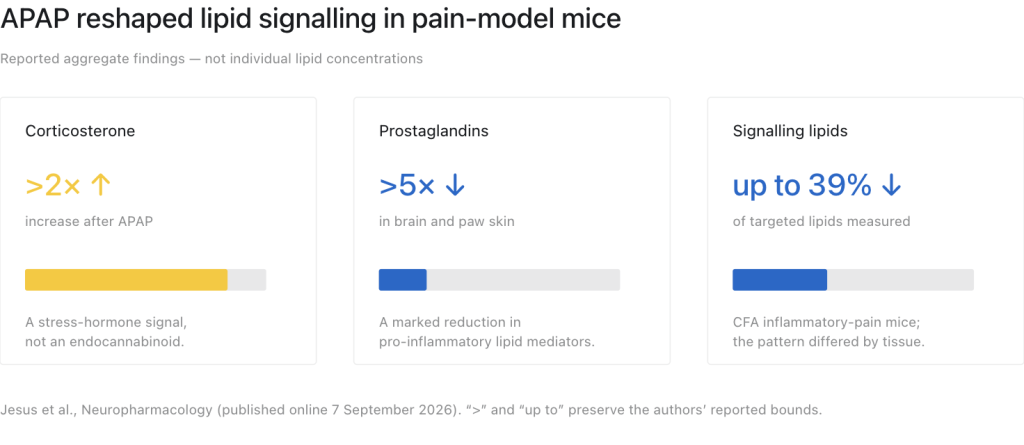
Perhaps the most striking part of the paper is not one enzyme or one receptor. It is the lipidomic picture.
APAP appears to reshape arachidonic-acid-derived lipid signalling: it sharply reduced prostaglandins while its analgesic effect still depended on intact DAGL–MAGL–CB1 signalling. This is not evidence that APAP simply induces endocannabinoids; it points to a more selective, tissue-dependent reorganisation of lipid signalling.
That matters because prostaglandins, endocannabinoids and many related lipids do not operate in isolation. They are woven into inflammatory signalling, stress biology, immune activity and neural communication.
We may have been asking the wrong question when we ask, “What is paracetamol’s mechanism of action?” Singular.
A more useful question is: how does paracetamol reshape lipid signalling in different tissues during different kinds of pain?
What does this mean for humans?
It matters.
The 2-AG–DAGL–MAGL–CB1 signalling architecture is deeply conserved across vertebrates. This gives us a strong biological basis to expect that a related mechanism operates in humans. The ECS is not an obscure mouse-only system.
Human research is still needed to establish the relative contribution of this pathway to paracetamol analgesia, and how that contribution differs by dose, tissue and pain condition. But the absence of that final translational step should not be used to minimise the importance of these findings. The core biology is conserved; the new work provides a powerful mechanistic framework for studying paracetamol in people.
The lesson for ECS education
For years, the ECS has been treated as peripheral knowledge—interesting if you work with cannabis, perhaps, but not central to mainstream pharmacology.
Paracetamol challenges that view.
One of the world’s most widely used pain medicines now has evidence connecting its analgesic effects to CB1 receptors, DAGL, MAGL, 2-AG-related lipid signalling, prostaglandins and stress hormones. It is difficult to argue that the ECS is irrelevant to medical education when it may be part of the story behind a drug prescribed and recommended every day.
The science is evolving, and it is pointing in one direction: the ECS is physiology.
It does not begin with cannabis, and it does not end there.
References
Jesus CHA, Wirt JL, Woodward T, et al. Acetaminophen alters endogenous lipid signaling and attenuates pathological pain through a mechanism requiring diacylglycerol lipase, monoacylglycerol lipase and cannabinoid CB1 receptors in mice. Neuropharmacology. Published online September 7, 2026.
Dvorakova M, Bosquez-Berger T, Billingsley J, et al. Acetaminophen inhibits diacylglycerol lipase synthesis of 2-arachidonoyl glycerol: Implications for nociception. Cell Reports Medicine. 2025;6:102139.