
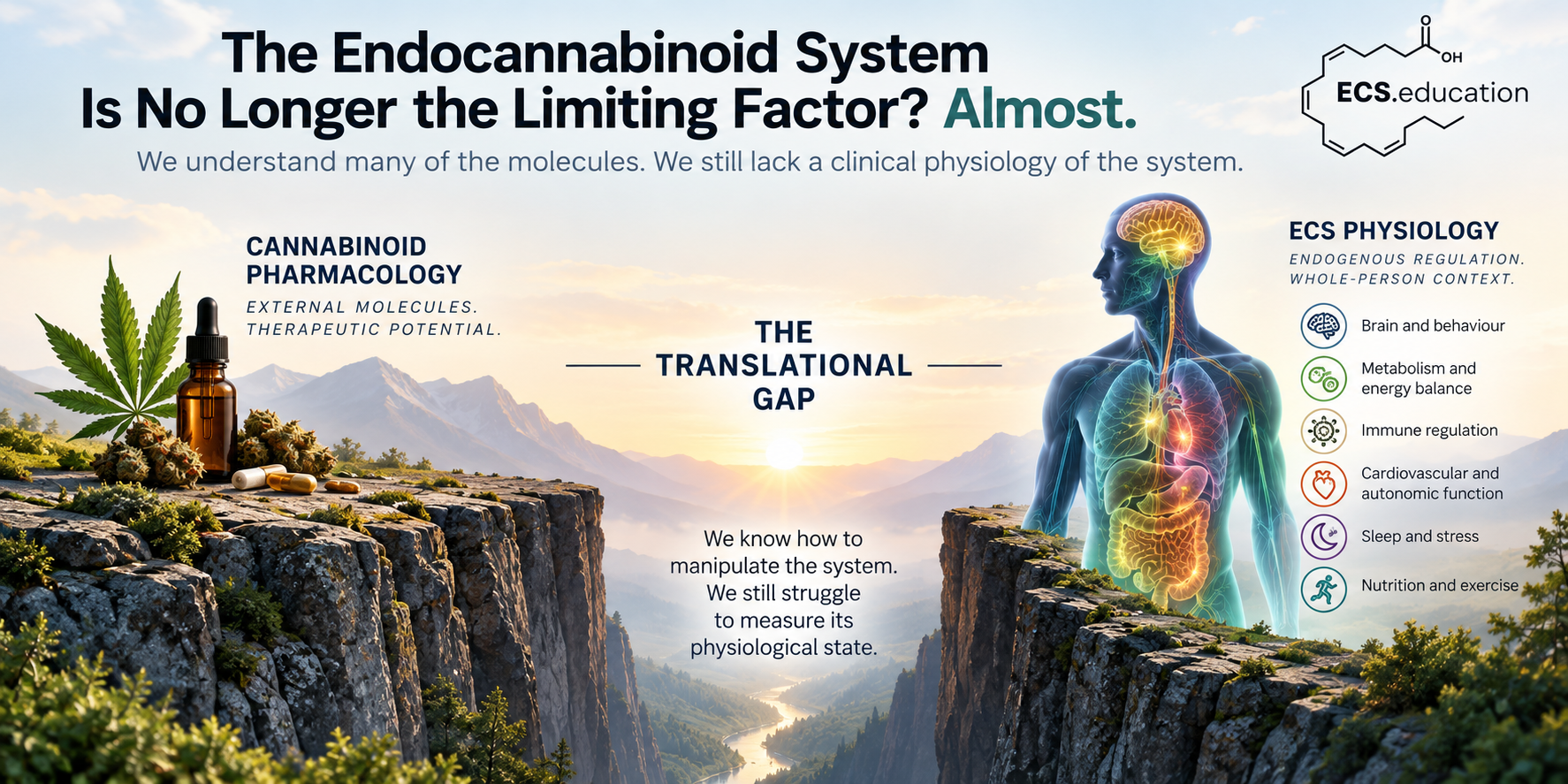
Policy and stigma have delayed cannabinoid medicine, but the clinical translation of ECS physiology remains incomplete
A new review published in Clinical Therapeutics makes an argument that deserves serious attention from anyone working with the endocannabinoid system [1].
The article, titled “The Endocannabinoid System is No Longer the Limiting Factor: Why Policy and Stigma Continue to Delay Cannabinoid-Based Medicine,” argues that the persistent gap between extensive mechanistic knowledge of the endocannabinoid system and the comparatively limited number of high-quality clinical trials of cannabinoid-based therapies cannot reasonably be explained by lack of biological plausibility alone.
Instead, the authors point to a combination of regulatory restriction, fragmented legislation, limited public funding, inconsistent product standardization, professional stigma and inadequate medical education [1].
I largely agree with that assessment.
Cannabinoid research has developed under conditions that would be considered highly unusual in most other areas of pharmacology. Cannabis prohibition did not simply restrict access to a plant. It influenced access to research material, increased regulatory complexity, shaped funding priorities, affected which researchers entered the field and contributed to a clinical environment in which both patients and healthcare professionals often had to navigate medicinal cannabinoid use within a framework inherited from drug-control policy rather than ordinary therapeutic development [1].
It is therefore entirely reasonable to challenge the common statement that cannabis medicine simply “lacks evidence” without also asking why the evidence base developed in such an uneven way.
Where I would add some caution is in the broader claim that the biological understanding of the ECS is no longer an important limiting factor. We may know enough about the ECS to justify considerably more clinical investigation of cannabinoid therapeutics than is currently being performed, but that is not quite the same thing as saying that our understanding of ECS physiology is sufficiently mature for biology itself to no longer constrain translation.
We know many of the components, but not yet the physiological state of the system
More than three decades of research have provided an increasingly detailed molecular description of the ECS.
We know the canonical cannabinoid receptors CB1 and CB2, the endogenous ligands anandamide and 2-arachidonoylglycerol, and many of the enzymes involved in their synthesis and degradation. We also know that this signalling network extends considerably beyond the original canonical definition and interacts with TRP channels, PPARs and a broader family of lipid mediators now often discussed as part of the endocannabinoidome [2,3].
This literature has connected ECS signalling to pain, metabolism, stress adaptation, immune regulation, appetite, neuroplasticity, sleep, cardiovascular physiology and many other processes [2].
What remains much less developed is the ability to determine what this system is actually doing in an individual human being at a particular point in time.
Knowing that insulin exists, identifying the insulin receptor and mapping its downstream signalling pathways would never have been sufficient to establish modern endocrinology. Clinical usefulness emerged when molecular understanding could be related to measurable physiological state: glucose concentration, insulin levels, HbA1c, glucose tolerance, insulin sensitivity and tissue-level metabolic responses.
The ECS has not yet undergone an equivalent transition.
In routine medicine, we generally cannot determine whether CB1-associated signalling in a given physiological compartment is appropriately adaptive, excessive, insufficient or compensating for another disturbance. We have very limited ability to infer receptor availability or coupling in vivo outside specialized research settings, and we rarely integrate variables such as insulin signalling, dietary fatty-acid availability, sleep, exercise, stress physiology, autonomic state or previous cannabinoid exposure when interpreting how cannabinoid pharmacology may behave in an individual patient.
Each of these factors can potentially alter the biological context into which a cannabinoid drug is introduced, which is difficult to regard as a minor remaining detail from a pharmacological perspective.
The article highlights one translational gap, but there is another
The new review focuses primarily on the pathway from ECS biology to cannabinoid therapeutics.
That pathway can be simplified as:
ECS biology → cannabinoid pharmacology → clinical trials → cannabinoid medicine
The structural barriers described by the authors clearly interfere with this progression. Regulatory restrictions make clinical research more difficult. Product heterogeneity complicates reproducibility. Limited public funding increases dependence on commercial actors. Inadequate education and persistent stigma reduce both research activity and clinical confidence [1].
But there is another translational pathway that has received far less attention:
ECS biology → measurable human physiology → disease mechanisms, prevention and precision medicine
This second pathway is important because the ECS is not primarily a cannabis system.
Cannabis contains molecules capable of interacting with an endogenous regulatory network, but that network is active continuously in people who have never used cannabis. Its canonical endogenous ligands are lipid-derived, and the wider endocannabinoidome is increasingly understood in the context of membrane fatty-acid composition, substrate availability, enzymatic competition and metabolic state [2,3].
If we continue to frame translation mainly around cannabinoids, we risk learning considerably more about how to pharmacologically manipulate the ECS without developing an equivalent understanding of the underlying physiology being manipulated.
Important gaps remain around how dietary fatty-acid composition changes the substrate landscape from which endocannabinoids and related lipid mediators are synthesized [3], how insulin resistance might influence CB1 regulation in insulin-sensitive tissues, and how chronic agonist exposure alters receptor availability and subsequent responsiveness. A particularly relevant recent study showed that insulin can increase hepatic CB1 expression by suppressing lysosomal degradation through ERK-dependent signalling, providing direct evidence that receptor abundance itself can be metabolically regulated [4].
We also need a much better understanding of how exercise, fasting, sleep, autonomic regulation, glucocorticoids and inflammatory state modify ECS signalling, including the extent to which central and peripheral ECS states can diverge within the same individual. Exercise alone provides a useful example: a systematic review and meta-analysis found consistent acute increases in circulating anandamide and 2-AG, while also identifying substantial heterogeneity related to factors including exercise intensity, fitness, measurement timing and fasting state [5].
Can combinations of molecular and physiological measurements eventually allow us to infer clinically meaningful functional states of this system?
That question is relevant whether a patient uses medicinal cannabis or has never been exposed to a phytocannabinoid.
Biological state matters for pharmacology
One practical consequence of this distinction is that the same cannabinoid exposure cannot automatically be assumed to represent the same physiological intervention in every patient.
A receptor agonist is acting on a biological system whose ligand pressure, receptor abundance, coupling efficiency, intracellular signalling context and previous exposure history may all differ.
This is not unusual in pharmacology. It is simply particularly difficult to evaluate in the ECS because we lack accessible clinical measures of the underlying state.
A patient with chronic high-THC exposure and reduced CB1 availability is not biologically equivalent to a cannabinoid-naive patient. Human PET data provide direct evidence for this type of adaptation: cannabis-dependent men showed approximately 15% lower cerebral CB1 availability than controls at baseline, with the group difference disappearing rapidly during monitored abstinence [6].
A patient with metabolic disease and altered peripheral CB1 regulation may similarly present a very different signalling context from a metabolically healthy patient [4].
Likewise, a cannabinoid introduced during acute stress, sleep deprivation, fasting or post-exercise recovery is entering a physiological environment that may differ substantially from the same dose administered under another condition.
We routinely accept this logic elsewhere in medicine. Antihypertensive pharmacology is interpreted in relation to cardiovascular state. Glucose-lowering drugs are interpreted in relation to metabolic state. Thyroid drugs are interpreted in relation to circulating hormones and feedback regulation.
Cannabinoid medicine still has relatively little capacity to characterize the functional state of the system receiving the drug, which is one reason I think it is premature to regard ECS biology itself as no longer limiting.
Medical education is where these two problems intersect
One of the strongest parts of the Clinical Therapeutics article is its emphasis on education.
The authors correctly identify inadequate training among healthcare professionals as a contributor to uncertainty, stigma and low prescribing confidence [1], but the educational problem may be broader than a lack of training in medicinal cannabis.
Many healthcare professionals receive very little structured education about the ECS as normal physiology. We previously examined this disconnect between the size of the ECS scientific literature and its representation in medical education, including its limited treatment within standard physiology teaching [7]. More recently, a 2025 consensus process published in JAMA Network Open identified understanding the basic ECS as one of six core competencies for medical-cannabis education, while noting that standardized cannabis education remains absent from most medical-school curricula [8].
This matters because the way a physiological system is introduced influences how it is subsequently conceptualized.
If students first encounter the ECS through cannabis, THC, CBD and medicinal cannabinoid prescribing, it becomes easy to understand why the system is mentally categorized as part of cannabis pharmacology. If education instead begins with endogenous lipid signalling, receptor regulation, membrane biology, metabolic state and physiological adaptation, cannabinoids become what they pharmacologically are: one group of external molecules capable of perturbing an existing endogenous regulatory system.
It also helps explain why ECS omission can persist even in research areas where cannabis is completely irrelevant to the experimental question.
Researchers can study metabolism, exercise adaptation, inflammation, stress, sleep or cardiovascular regulation without considering the ECS, not necessarily because evidence is absent, but because the system was never incorporated into the physiological framework they were trained to use.
This is one reason I started the ongoing #ECSOmissionChallenge on LinkedIn. The problem is not always that ECS research cannot be performed. Sometimes the problem is simply that nobody thought to include it.
Regulatory reform alone will not solve the wider translational problem
It is useful to consider what would happen if many of the structural barriers described by de Souza and colleagues disappeared.
Cannabinoid trials could become easier to conduct. Standardization could improve. Larger randomized studies could become more feasible. Public funding might diversify the clinical questions being asked. Healthcare professionals could receive better guidance on dosing, interactions and patient selection.
All of that would represent progress.
But researchers studying insulin resistance could still overlook CB1 biology. Exercise physiologists could still omit endocannabinoid signalling from models of adaptation. Sleep researchers could still investigate autonomic and neurophysiological regulation without considering the ECS. Nutrition research could still discuss fatty acids primarily as energy substrates or inflammatory mediators while overlooking their role as precursors to bioactive lipid signalling molecules [3].
Medical students could also still complete their training with only a superficial understanding of a regulatory system that intersects with multiple major areas of physiology [7,8].
That is why the translational problem extends beyond cannabis policy. Regulation has restricted what could be studied, while education has also influenced what researchers and clinicians think is worth studying in the first place.
From cannabinoid pharmacology toward ECS systems biology
I therefore see the new Clinical Therapeutics article as an important contribution to the field, but also as an opportunity to extend the discussion.
The authors are right that cannabinoid medicine has developed within a structural environment that has delayed evidence generation and distorted normal clinical translation. However, the next phase should not simply be about removing barriers so that more cannabinoid trials can be performed.
We also need to improve our ability to understand the physiological system those drugs act upon.
For me, this is where the field needs to move from cannabinoid pharmacology toward ECS systems biology.
That means studying receptor pharmacology together with metabolic state, lipid substrate availability, autonomic regulation, sleep, exercise, inflammation, ageing and previous drug exposure rather than treating each of these as unrelated domains. It also means developing biomarkers capable of describing at least part of the functional state of the system over time.
The relevant clinical question then becomes broader than which cannabinoid should be given at which dose:
What is the biological state of the system before we intervene in it, and how does that state influence the response?
This is, in my view, where some of the most interesting ECS research now lies.
Is the ECS really no longer the limiting factor?
If the statement means that mechanistic uncertainty should no longer be used as a reason to avoid rigorous clinical investigation of cannabinoid therapeutics, I agree.
There is already more than enough biological plausibility to justify a much stronger clinical research effort, and regulatory barriers should not continue to create an evidence deficit that is then used to justify the barriers themselves [1].
But if the statement is interpreted more broadly to mean that the biology of the ECS is sufficiently understood for it no longer to constrain clinical translation, I think the evidence points in another direction.
We know a great deal about the molecular architecture of the system. What we still lack is something closer to a clinical physiology of the ECS: an ability to characterize its functional state, understand tissue-specific regulation, recognize maladaptive signalling states and follow those states longitudinally in humans.
Cannabis policy has undoubtedly delayed cannabinoid medicine, and removing those barriers is necessary. But there is another task that cannot be solved through drug-policy reform alone: integrating the ECS into mainstream physiology so that researchers and clinicians learn to recognize the system even when no cannabis is involved.
If that happens, the result could be considerably broader than better cannabinoid prescribing. It could mark the beginning of a transition from cannabinoid medicine toward ECS medicine.
What is still missing is not another argument for why the ECS matters, but a way of incorporating it into the physiology that medicine already uses to understand human adaptation, disease and treatment response. Until that happens, we may become better at developing and prescribing cannabinoid medicines without becoming much better at understanding the biological system those medicines act upon.
References
- de Souza JA, Martins-Filho PR, de Souza Siqueira Quintans J, Quintans-Júnior L. The Endocannabinoid System is No Longer the Limiting Factor: Why Policy and Stigma Continue to Delay Cannabinoid-Based Medicine. Clinical Therapeutics. Published online September 11, 2026. PMID: 42728140.
- Rodríguez de Fonseca F, Del Arco I, Bermudez-Silva FJ, Bilbao A, Cippitelli A, Navarro M. The endocannabinoid system: physiology and pharmacology. Alcohol Alcohol. 2005;40(1):2–14. doi:10.1093/alcalc/agh110.
- Petrosino S, Fontecilla-Escobar J, Di Marzo V, Iannotti FA. Diet, microbiota, and lipidomics: How fatty acids shape the endocannabinoidome and host metabolism. Prog Lipid Res. 2026;102:101396. doi:10.1016/j.plipres.2026.101396.
- Liu SY, Ting CH, Hwang GS, et al. Insulin increases expression of cannabinoid receptor 1 by suppressing lysosomal degradation via ERK signaling pathway. Int J Med Sci. 2026;23(6):2027–2038. doi:10.7150/ijms.126308.
- Desai S, Borg B, Cuttler C, et al. A systematic review and meta-analysis on the effects of exercise on the endocannabinoid system. Cannabis Cannabinoid Res. 2022;7(4):388–408. doi:10.1089/can.2021.0113.
- D’Souza DC, Cortes-Briones JA, Ranganathan M, et al. Rapid changes in cannabinoid 1 receptor availability in cannabis-dependent male subjects after abstinence from cannabis. Biol Psychiatry Cogn Neurosci Neuroimaging. 2016;1(1):60–67. doi:10.1016/j.bpsc.2015.09.008.
- Broselid S, Gallow S. Bridging the gap: Integrating the endocannabinoid system into medical education. Int J Clin Med Case Stud. 2025;2(2):1027. doi:10.52768/3067-3852/1027.
- Zolotov Y, Mendoza Temple L, Isralowitz R, et al. Developing Medical Cannabis Competencies: A Consensus Statement. JAMA Netw Open. 2025;8(10). doi:10.1001/jamanetworkopen.2025.35049.