
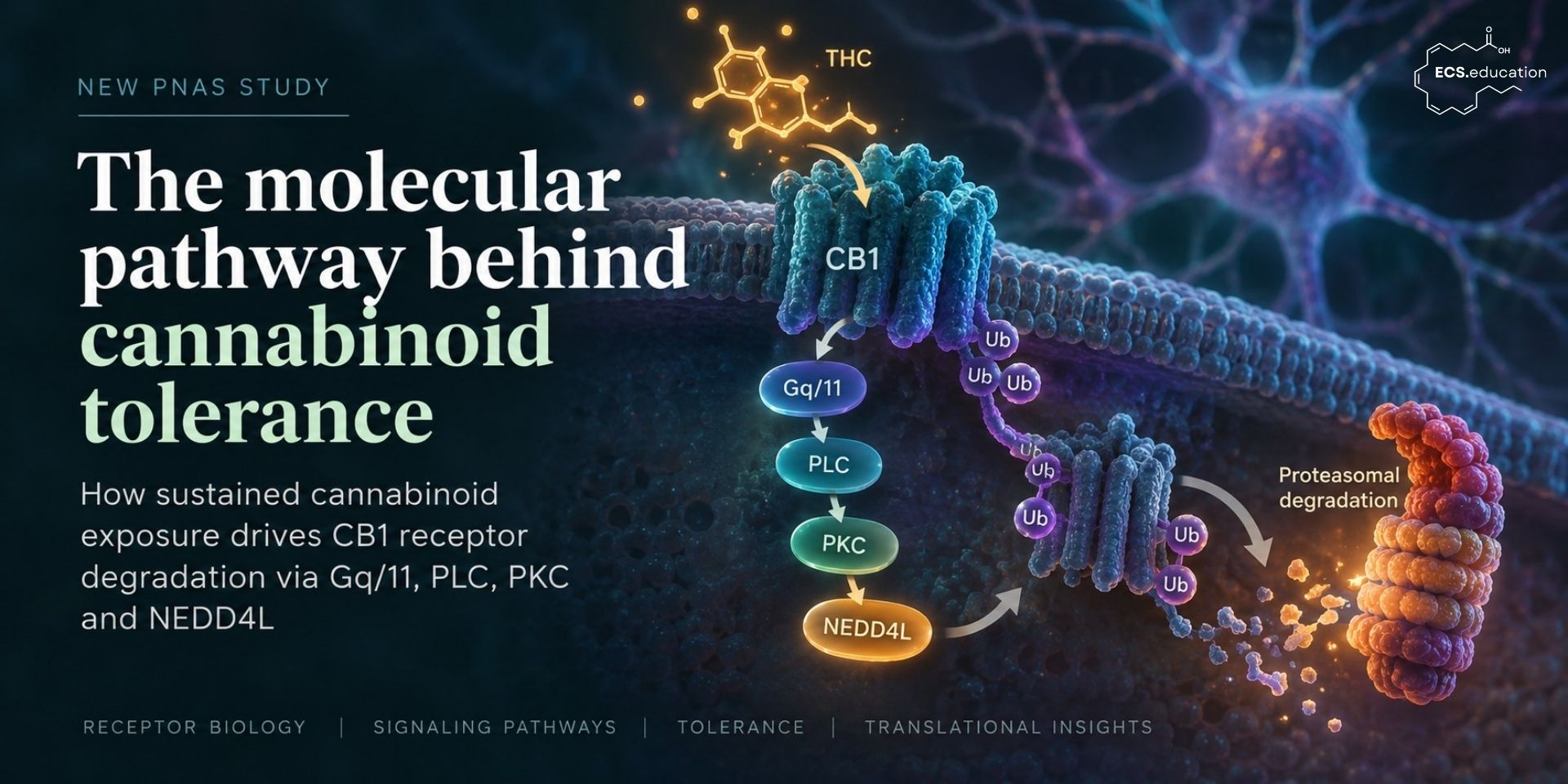
A new PNAS study identifies the molecular pathway linking sustained cannabinoid exposure to CB1 receptor degradation and tolerance
Cannabis tolerance is familiar. The receptor biology behind it has been less complete. We have known for decades that repeated THC exposure can reduce cannabinoid responsiveness and CB1 availability, but the molecular step connecting sustained receptor activation to actual loss of CB1 protein has remained surprisingly unclear.
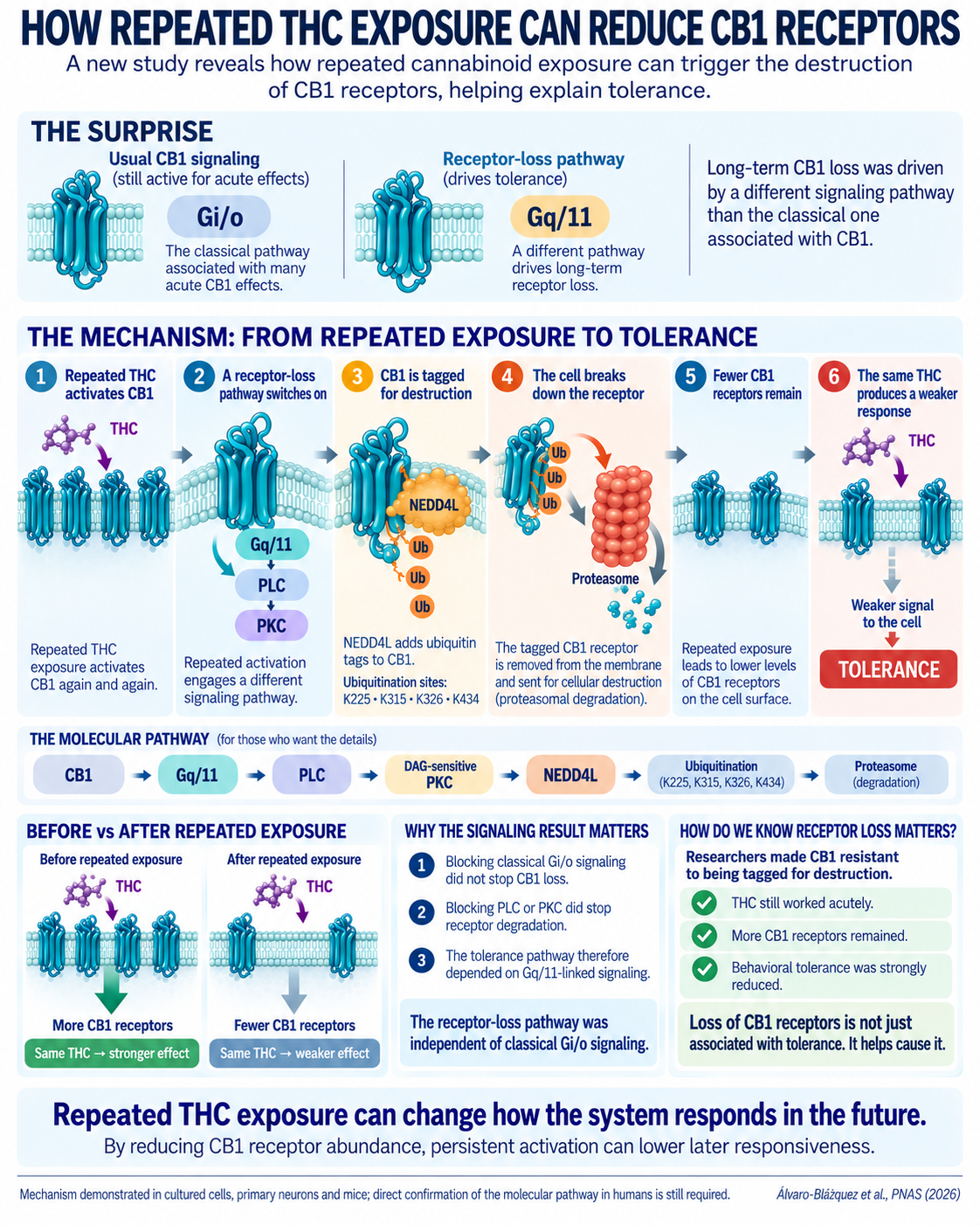
A new study published in PNAS now fills in a substantial part of that mechanism. Álvaro-Blázquez and colleagues show that cannabinoid activation can recruit a pathway involving Gq/11, phospholipase C, protein kinase C and the E3 ubiquitin ligase NEDD4L. NEDD4L ubiquitinates CB1 and promotes its proteasomal degradation. When this ubiquitination was prevented, receptor levels were preserved and the development of behavioural cannabinoid tolerance was strongly impaired in mice (Álvaro-Blázquez et al., 2026).
What caught my attention most was the signalling branch upstream of NEDD4L. The pathway responsible for CB1 loss was not dependent on the classical Gi/o signalling that dominates most descriptions of CB1 pharmacology. Instead, it depended on Gq/11 signalling through PLC and PKC (Álvaro-Blázquez et al., 2026).
This reinforces a point that is easy to lose when we use ‘tolerance’ as a single label: several distinct changes in receptor state can sit underneath the same declining response to THC.
CB1 adaptation is not one biological state
“CB1 downregulation” can easily become a catch-all term, but several distinct processes sit underneath it.
The classical model of relatively rapid CB1 desensitization involves receptor phosphorylation, recruitment of β-arrestins, reduced G-protein coupling and receptor internalization. Earlier work showed that desensitization and internalization can themselves be experimentally separated, which already tells us that a receptor can become less responsive without necessarily being eliminated from the cell (Jin et al., 1999).
The new study addresses a different level of regulation: loss of CB1 protein itself.
Cannabinoid-induced CB1 loss was prevented when components of the ubiquitin-proteasome system were inhibited, whereas lysosomal inhibition did not prevent the receptor loss observed under the experimental conditions. CB1 mRNA remained essentially unchanged, pointing to post-transcriptional regulation at the level of receptor protein turnover rather than reduced gene expression (Álvaro-Blázquez et al., 2026).
A transiently uncoupled CB1 receptor can potentially be resensitised. A receptor that has been ubiquitinated and degraded has to be replaced. Both situations may reduce cannabinoid responsiveness, but they represent very different biological states.
The Gq/11 finding changes the mechanistic picture
CB1 is conventionally described as a Gi/o-coupled GPCR. That description is correct, but it has never meant that Gi/o exhausts the signalling repertoire of the receptor.
More than 20 years ago, Lauckner, Hille and Mackie showed that CB1 could couple to Gq/11-family proteins and increase intracellular calcium, including in cultured hippocampal neurons (Lauckner et al., 2005). Gq/11 signalling nevertheless remained peripheral to the dominant model of CB1 pharmacology.
The new PNAS study gives that noncanonical coupling a much clearer role in CB1 adaptation.
When Gi/o signalling was inhibited with pertussis toxin, cannabinoid-induced ERK activation was blocked as expected, but NEDD4L activation was not. CB1 degradation also continued. By contrast, inhibition of either PLC or PKC prevented NEDD4L phosphorylation and prevented cannabinoid-induced receptor degradation (Álvaro-Blázquez et al., 2026).
The proposed sequence is therefore:
CB1 activation → Gq/11 → PLC → PKC → NEDD4L → CB1 ubiquitination → proteasomal degradation
From a systems perspective, this is more interesting than simply adding another signalling pathway to the CB1 map. The pathway changes how much receptor is available for subsequent signalling. Activation history therefore becomes part of the future pharmacology of the receptor.
CB1 recruits the machinery that destroys CB1
At the centre of this pathway is NEDD4L, an E3 ubiquitin ligase.
Ubiquitination is one of the mechanisms cells use to regulate protein fate. Depending on context, ubiquitin can influence trafficking, localisation or degradation. Here, cannabinoid stimulation induced PKC-dependent phosphorylation of NEDD4L at serine 448, after which NEDD4L was recruited to CB1 and ubiquitinated four intracellular lysine residues:
K225, K315, K326 and K434 (Álvaro-Blázquez et al., 2026).
These modifications promoted proteasomal clearance of the receptor.
The pathway can therefore be reduced to a relatively simple adaptive sequence:
persistent CB1 activation → receptor ubiquitination → receptor loss → reduced future responsiveness
This is a form of negative feedback operating at the level of receptor abundance, not merely acute signalling efficacy.
Preventing ubiquitination separates acute CB1 signalling from tolerance
The investigators engineered CB1 receptors in which the intracellular lysines required for ubiquitination were replaced. These receptors still mediated an acute cannabinoid response, but they were resistant to the subsequent reduction in receptor abundance. Behavioural tolerance was correspondingly strongly impaired (Álvaro-Blázquez et al., 2026).
That experiment separates two phenomena that are often discussed together: acute cannabinoid signalling and the adaptive machinery that reduces receptor availability after repeated exposure.
In this model, ubiquitination is not merely a biochemical correlate of tolerance. Interfering with the process changes the tolerance phenotype.
Five days of repeated THC was sufficient to produce tolerance
The mice received 10 mg/kg THC intraperitoneally once daily for five consecutive days. By day 5, animals receiving THC alone had developed tolerance across the classical cannabinoid tetrad, including analgesia, hypolocomotion, catalepsy and hypothermia. The hypothermia response was somewhat different, as proteasome inhibition only partially prevented tolerance to that endpoint, suggesting that additional targets or regulatory mechanisms contribute there (Álvaro-Blázquez et al., 2026).
Using conventional body-surface-area scaling, the 10 mg/kg mouse dose corresponds to a rough HED of ~0.81 mg/kg, or roughly 50–70 mg for an adult weighing 60–90 kg (Nair & Jacob, 2016).
These numbers should not be interpreted as pharmacokinetic equivalents. The mice received THC intraperitoneally, whereas human cannabis exposure is typically inhaled or oral. Absorption, first-pass metabolism, formation of 11-OH-THC, peak concentrations, distribution and species-specific metabolism all differ. The calculation is useful only as an allometric reference.
The timescale itself is notable. Under a relatively high daily THC exposure, substantial CB1 adaptation and behavioural tolerance were evident after only five days.
Cannabinoid treatment is often discussed as though dose changes while the biological target remains comparatively stable. This study gives us good reason to question that assumption. Under sufficient agonist pressure, CB1 receptor biology can change on a timescale of days.
Human PET studies show that this receptor state is also reversible: CB1 availability begins to recover when chronic cannabis exposure stops, with measurable changes occurring within days of abstinence (Hirvonen et al., 2012; D’Souza et al., 2016).
Human cannabis tolerance already tells us that receptor state changes
The molecular pathway described here has not yet been demonstrated directly in humans, but the broader phenomenon it is trying to explain is well established.
Controlled human pharmacology has shown substantial tolerance to several effects of THC. In a study comparing frequent cannabis users with controls, D’Souza and colleagues administered 0, 2.5 and 5 mg intravenous THC. Frequent users showed blunted psychotomimetic, perceptual, cognitive, anxiogenic and cortisol responses (D’Souza et al., 2008).
Importantly, the adaptation was not uniform across all endpoints. The euphoric or “high” response was comparatively preserved.
That result is useful because it argues against treating “THC tolerance” as one global state. Different physiological and behavioural domains can adapt differently.
PET studies then added evidence that the receptor system itself changes. Hirvonen and colleagues reported approximately 20% lower cortical CB1 receptor availability in chronic daily cannabis smokers, with availability increasing again during monitored abstinence (Hirvonen et al., 2012).
A later [¹¹C]OMAR PET study found approximately 15% lower CB1 availability in cannabis-dependent men at baseline. After two days of monitored abstinence, the group difference was no longer statistically evident, with recovery continuing thereafter (D’Souza et al., 2016).
PET availability is not synonymous with receptor protein abundance, and neither study tells us whether NEDD4L mediated the human changes. The molecular pathway identified by Álvaro-Blázquez and colleagues therefore remains a preclinical mechanism.
Taken together, the evidence is internally coherent: human pharmacology shows changing responsiveness, PET shows changing CB1 availability, and the new experimental work identifies a pathway capable of converting repeated CB1 activation into receptor degradation.
The dose describes the input, not the state of the target
Cannabinoid medicine is usually described from the drug side: milligrams of THC, route of administration, dosing frequency, product composition and THC:CBD ratio.
Those variables are essential, but they describe the input.
They do not describe the state of the receptor system receiving that input.
If sustained THC exposure changes CB1 abundance, coupling or trafficking, then the same nominal dose given at two different points in time does not necessarily represent the same pharmacological event. The ligand can remain unchanged while the target system has adapted.
This distinction becomes clinically relevant when dose requirements change over time. A patient who initially obtained a therapeutic effect at one level of THC exposure and later requires substantially more could be experiencing progression of the underlying condition, pharmacokinetic differences, altered administration, behavioural factors or receptor-level adaptation.
The point is not to assume that tolerance is always responsible. It is to stop assuming that the changing dose requirement must reflect only the disease being treated.
The biological response to the drug can itself become a moving variable.
Why “ECS tone” is too one-dimensional
This study also illustrates a broader problem with how the endocannabinoid system is often described.
Terms such as “high ECS tone” and “low ECS tone” compress several separable variables into a single dimension. At minimum, CB1 function depends on ligand pressure, receptor abundance, coupling state, subcellular trafficking and receptor turnover.
Those variables do not necessarily move in the same direction.
A system can have high agonist pressure while simultaneously developing reduced receptor availability. A receptor can remain present but become poorly coupled. Another receptor population may be internalized, recycled or degraded. Different tissues and neuronal circuits may adapt at different rates.
The new paper adds a defined mechanism to one of these variables: receptor turnover.
It also explains why apparently contradictory observations can coexist. High cannabinoid exposure and low CB1 availability are not opposites. Under sustained agonist pressure, one can drive the other.
CB1 turnover may extend beyond drug tolerance
The paper also raises the possibility that the CB1–NEDD4L axis extends beyond drug tolerance.
NEDD4L is involved in neuronal protein regulation, and the paper points to links between protein ubiquitination, CB1-dependent long-term depression, AMPA receptor regulation and neuronal excitability. The authors therefore suggest that neurotransmission-induced CB1 activation could potentially recruit NEDD4L in the context of synaptic plasticity as well as drug tolerance (Álvaro-Blázquez et al., 2026).
This remains speculative, but if receptor abundance is adjusted according to prior signalling history, then CB1 turnover could plausibly contribute to how neural circuits regulate their sensitivity to future endocannabinoid signalling.
In that case, the mechanism identified here would sit within a broader adaptive role for CB1 rather than being restricted to cannabis exposure.
Where the human evidence begins and ends
The molecular pathway identified by Álvaro-Blázquez and colleagues was demonstrated in engineered cells, primary neurons and mice. It has not yet been directly demonstrated in humans.
In humans, experimental pharmacology already shows that frequent cannabis exposure alters responsiveness to THC (D’Souza et al., 2008), while PET studies show lower measurable CB1 availability during chronic exposure and recovery during abstinence (Hirvonen et al., 2012; D’Souza et al., 2016). What the new study adds is a mechanistic level that cannot yet be demonstrated in humans: cannabinoid activation engaged a Gq/11–PLC–PKC–NEDD4L pathway that ubiquitinated CB1, promoted proteasomal degradation and contributed causally to behavioural tolerance in mice (Álvaro-Blázquez et al., 2026).
The translational question is whether that same degradation pathway contributes to the changes in CB1 availability observed in humans.
From cannabinoid pharmacology to ECS systems biology
For decades, cannabinoid tolerance could be measured behaviourally. Controlled human pharmacology showed that the response to THC depends on exposure history (D’Souza et al., 2008). PET later showed that CB1 receptor availability itself changes during chronic exposure and abstinence (Hirvonen et al., 2012; D’Souza et al., 2016).
The new study adds another layer by identifying a molecular pathway capable of translating repeated receptor activation into receptor destruction (Álvaro-Blázquez et al., 2026).
What I take from this is that the pharmacological target itself is adaptive. Persistent stimulation can alter receptor abundance, which in turn changes future signalling capacity. When exposure changes, receptor state can move again.
That has consequences for how cannabinoid treatment is interpreted. A prescribed THC dose describes the external input, but not the biological state of the CB1 system receiving it. If receptor abundance, coupling and turnover are changing with exposure history, then the same dose can act on a meaningfully different system over time.
This is why I increasingly think cannabinoid medicine needs to move beyond dose-centric pharmacology. The more useful framework is one that considers both exposure and receptor state, and treats tolerance as a dynamic systems-level adaptation rather than simply a need for more THC.
That is what I mean by ECS systems biology.
References
Álvaro-Blázquez A, Rodrigues RS, Montero-Fernández C, et al. Cannabinoid tolerance relies on CB1 receptor ubiquitination by NEDD4L. Proc Natl Acad Sci U S A. 2026;123(35):e2606671123. doi:10.1073/pnas.2606671123
D’Souza DC, Cortes-Briones JA, Ranganathan M, et al. Rapid Changes in Cannabinoid 1 Receptor Availability in Cannabis-Dependent Male Subjects After Abstinence From Cannabis. Biol Psychiatry Cogn Neurosci Neuroimaging. 2016;1(1):60-67. doi:10.1016/j.bpsc.2015.09.008
D’Souza DC, Ranganathan M, Braley G, et al. Blunted psychotomimetic and amnestic effects of delta-9-tetrahydrocannabinol in frequent users of cannabis. Neuropsychopharmacology. 2008;33(10):2505-2516. doi:10.1038/sj.npp.1301643
Hirvonen J, Goodwin RS, Li CT, et al. Reversible and regionally selective downregulation of brain cannabinoid CB1 receptors in chronic daily cannabis smokers. Mol Psychiatry. 2012;17(6):642-649. doi:10.1038/mp.2011.82
Jin W, Brown S, Roche JP, et al. Distinct domains of the CB1 cannabinoid receptor mediate desensitization and internalization. J Neurosci. 1999;19(10):3773-3780. doi:10.1523/JNEUROSCI.19-10-03773.1999
Lauckner JE, Hille B, Mackie K. The cannabinoid agonist WIN55,212-2 increases intracellular calcium via CB1 receptor coupling to Gq/11 G proteins. Proc Natl Acad Sci U S A. 2005;102(52):19144-19149. doi:10.1073/pnas.0509588102
Nair AB, Jacob S. A simple practice guide for dose conversion between animals and human. J Basic Clin Pharm. 2016;7(2):27-31. doi:10.4103/0976-0105.177703