
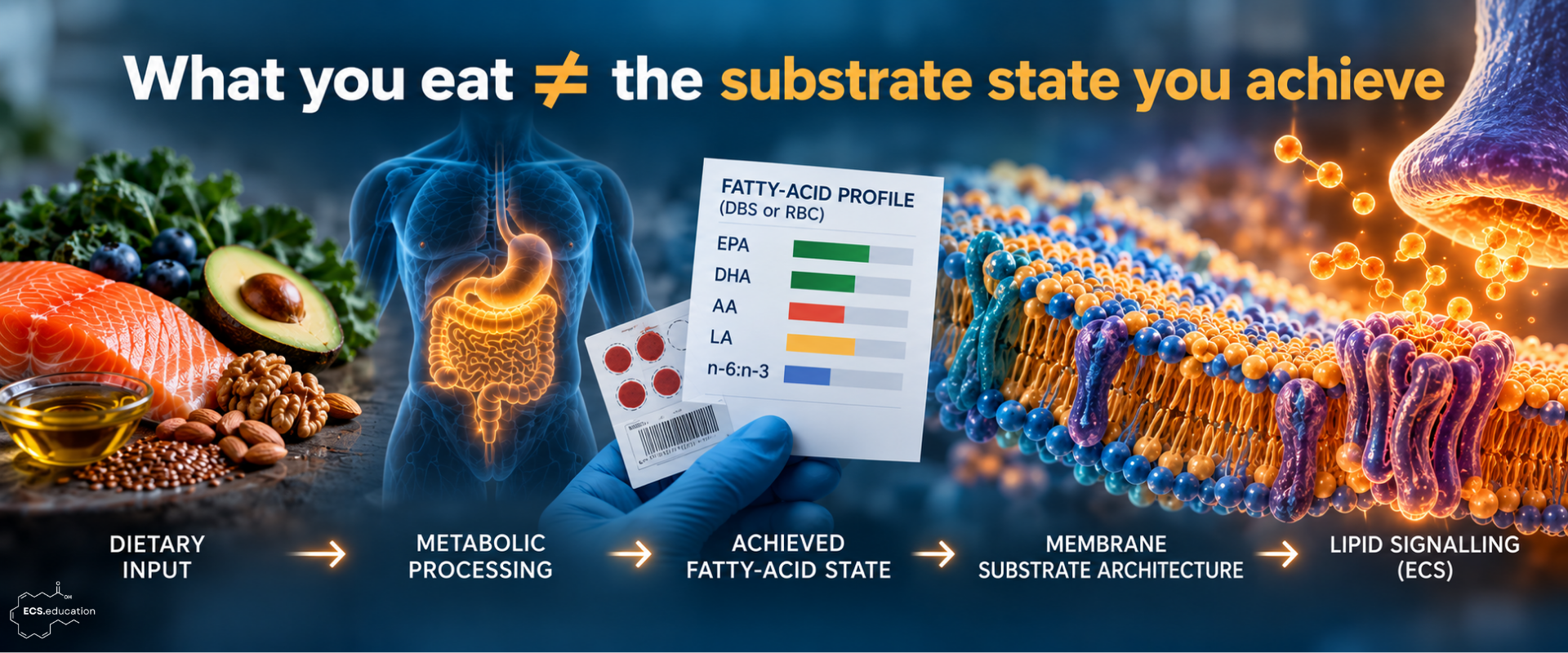
New human tracer data sharpen the case for a substrate-driven endocannabinoid system — and for measuring the fatty-acid state actually achieved, not just the dose consumed.
For years, I have argued that the endocannabinoid system has to be understood as a substrate-dependent signalling system.
But even that statement can be too simple if it is reduced to diet alone.
A new human tracer study from Pawlosky, Lin, Hibbeln and Salem makes the missing layer very clear: the biological fate of a fatty-acid substrate depends on the physiological state of the person receiving it.
The study used controlled dietary interventions, deuterium-labelled linoleic acid and compartmental modelling to follow n-6 PUFA metabolism in vivo. Rather than measuring only static concentrations, the authors estimated precursor uptake, downstream synthesis and turnover across the pathway toward arachidonic acid.
That distinction is important.
A concentration tells us how much of a fatty acid is present at one moment.
Flux tells us what the system is doing with it.
And for a lipid-derived signalling system, flux is often the more interesting variable.
Dietary intake is not biological exposure
The fish-based diet provides the cleanest example.
In non-smoking participants, it produced large increases in plasma EPA and DHA. In non-smoking males, EPA increased by approximately 345% and DHA by around 220% relative to the self-selected diet. Similar increases were observed in non-smoking females.
In smokers, the same dietary intervention did not produce the same increase.
The authors interpret this as impaired accumulation or maintenance of long-chain n-3 fatty acids under smoking exposure.
The substrate was delivered.
The metabolic result was different.
So the biologically relevant relationship is not:
dietary dose → fatty-acid status
It is closer to:
dietary substrate × physiological state → achieved fatty-acid state
That is a much better systems-level description of what is happening.
Arachidonic acid makes this especially relevant to the ECS
The paper becomes particularly interesting when we look at arachidonic acid, 20:4n-6.
Arachidonic acid contributes to membrane phospholipid pools that feed several endocannabinoid precursor pathways. In simplified terms, AA-containing phospholipids can support DAG-derived 2-AG synthesis, while arachidonoyl transfer into NAPE species provides precursor material for AEA synthesis.
This does not mean that plasma arachidonic acid is equivalent to 2-AG or anandamide.
But it does mean that the metabolic handling of arachidonic acid sits upstream of the substrate architecture from which major endocannabinoids are produced.
And in this study, arachidonic-acid metabolism was strongly state-dependent.
In male smokers, the proportion of labelled 20:3n-6 converted toward labelled arachidonic acid was higher than in non-smokers under some dietary conditions. On the beef-based diet, the value was 128% in smokers versus 75% in non-smokers. At the same time, turnover of labelled arachidonic acid on the fish-based diet was markedly lower in smokers: 1.6% versus 7.0% in non-smokers.
That is exactly why static concentration data can become misleading.
A pool can look similar while the system underneath it is behaving very differently.
Synthesis can rise.
Turnover can fall.
Oxidative loss can change.
Membrane incorporation can change.
The same measured concentration can therefore sit on top of very different metabolic dynamics.
For a lipid-derived signalling system, that distinction is not trivial.
Uptake is not utilization
The alcohol-use-disorder group adds another useful layer.
These participants showed greater uptake of labelled linoleic acid, but poorer downstream utilization toward arachidonic acid.
In males with alcohol use disorder, labelled arachidonic-acid synthesis and turnover were both reduced relative to male smokers. The synthetic rates for 20:3n-6 and arachidonic acid formation were reported at only 38% and 19% of those observed in the smoker comparison group.
The authors describe this as a substantial reduction in n-6 PUFA metabolic capacity.
substrate entry ≠ substrate utilization
A precursor can enter the system efficiently and still fail to generate the expected downstream product.
That is one reason dose-based nutrition studies can miss important biology.
Knowing what someone consumed is not the same as knowing what their metabolism did with it.
The sex differences are state-dependent too
Another feature of the paper that deserves attention is the interaction with sex.
Among non-smoking participants, the authors found relatively few major sex differences in n-6 PUFA metabolism.
But under smoking exposure, substantial differences appeared.
Female smokers showed lower arachidonic-acid formation and turnover than male smokers under self-selected dietary conditions. The authors report much lower synthesis and turnover, with arachidonic-acid synthetic rate in female smokers only a fraction of that measured in males.
I find this important because it illustrates a broader systems-biology point: biological differences are not always obvious at baseline.
Sometimes they emerge only when a system is perturbed.
The phenotype is often not in the resting state. It is in the response.
This is not yet an ECS study
It is important to be precise here.
This paper did not measure:
- 2-AG
- anandamide
- CB1 or CB2 signalling
- DAGL
- MAGL
- FAAH
- tissue-specific endocannabinoid tone
So the paper does not demonstrate an ECS effect directly.
What it does provide is strong human evidence for something immediately upstream of a substrate-driven ECS model:
fatty-acid availability is not fixed by intake alone. It is shaped by metabolic state.
The study measures the first part of the chain:
dietary precursor → fatty-acid metabolism → circulating substrate state
The ECS implication begins after that.
If a physiological state alters arachidonic-acid synthesis, maintenance or turnover, then it is reasonable to ask whether it also alters the membrane substrate environment from which endocannabinoid signalling is generated.
That is the next experiment.
The substrate layer needs a metabolic layer
I think this paper sharpens one of my own working ideas.
I have often used the phrase:
Your ECS runs on what you eat.
I still think that is useful.
But biologically, the more precise version is:
Your ECS runs on what your metabolism makes available from what you eat.
That extra layer is crucial.
The sequence is not simply:
diet → membrane → ECS
It is more like:
dietary input → metabolic processing → fatty-acid state → membrane substrate architecture → lipid signalling
The metabolic-processing layer includes absorption, elongation, desaturation, oxidation, incorporation, maintenance and turnover. Pawlosky et al. directly show that several of these upstream processes — particularly precursor handling, long-chain PUFA formation, accumulation and turnover — are not invariant between people.
That makes substrate availability a dynamic physiological variable, not simply a dietary one.
Why this matters for omega-3 research
The same logic applies directly to omega-3 interventions.
If two people receive the same dose of EPA and DHA, but one incorporates and maintains those fatty acids efficiently while the other does not, then dose is a poor proxy for biological exposure.
The dose tells us what was administered.
The fatty-acid profile tells us what was achieved.
Tracer kinetics tell us how the system got there.
Those are three different biological questions.
This is why longitudinal fatty-acid profiling is so important if the real objective is to study biological remodeling rather than supplement adherence.
The bigger implication
This study fits a broader systems-biology principle:
Response = f(substrate, state)
The same dietary input does not produce the same biological state in every person.
Smoking altered the response to a fish-based diet. Alcohol misuse changed downstream n-6 metabolism despite greater precursor uptake. Sex differences became more apparent under perturbation. The organism is not a passive container for nutrients; it determines what those nutrients become.
That has an important practical consequence.
If we want to know whether a fatty-acid intervention actually changed the substrate environment, the dose consumed is not the endpoint.
A supplement log tells us what was taken.
A dietary record tells us what was eaten.
Neither tells us, by itself, what fatty-acid state was actually achieved.
Dose ≠ Achieved fatty-acid state ≠ Metabolic flux
The dose tells us what entered the intervention.
A DBS or RBC fatty-acid profile gives us a much closer readout of the achieved systemic fatty-acid state than intake alone.
Tracer kinetics tell us how that state was being generated and turned over.
Those are three different biological questions.
For most real-world studies, we will not have isotope tracers. But we can measure the fatty-acid profile.
That means we do not have to guess whether remodeling occurred.
We can look at the receipt.
If someone is taking EPA and DHA, the important question is not simply whether they took the capsules. It is whether EPA increased, whether DHA changed, whether the AA:EPA relationship moved, whether other membrane-relevant fatty acids shifted, and whether those changes were sustained over time.
The supplement dose is the intervention. The fatty-acid profile is the evidence that the intervention actually changed substrate state.
This distinction becomes especially important for the ECS because lipid signalling depends on the substrate environment that remains after absorption, metabolism, incorporation and turnover have already occurred.
So if we want to understand endocannabinoid tone, receptor adaptation or individual response, the more useful question is not:
What did this person consume?
It is:
What fatty-acid state did their metabolism actually create?
For a substrate-driven ECS framework, that is the measurement that matters more than intake alone.
The dose is upstream.
The biology is in the achieved profile.
What this study establishes
Diet, smoking, alcohol misuse and sex can alter precursor uptake, long-chain PUFA accumulation, arachidonic-acid synthesis and arachidonic-acid turnover.
What it suggests mechanistically
Those differences would be expected to alter the lipid substrate landscape available to membrane-derived signalling systems.
What remains to be tested
Whether those substrate differences translate into measurable changes in 2-AG, AEA, CB1 signalling or adaptive physiology.
That final step has not yet been demonstrated.
But the upstream biology is now much harder to ignore.
The ECS may run on what we eat, but metabolism decides what reaches the signalling machinery.
Reference
Pawlosky RJ, Lin YH, Hibbeln JR, Salem N Jr. Effects of diet, smoking and chronic alcohol misuse on plasma lipid profiles and n-6 essential fatty acid metabolism in males and females. Journal of Lipid Research. 2026. doi:10.1016/j.jlr.2026.101134.