
From metabolic drug to mood modulator
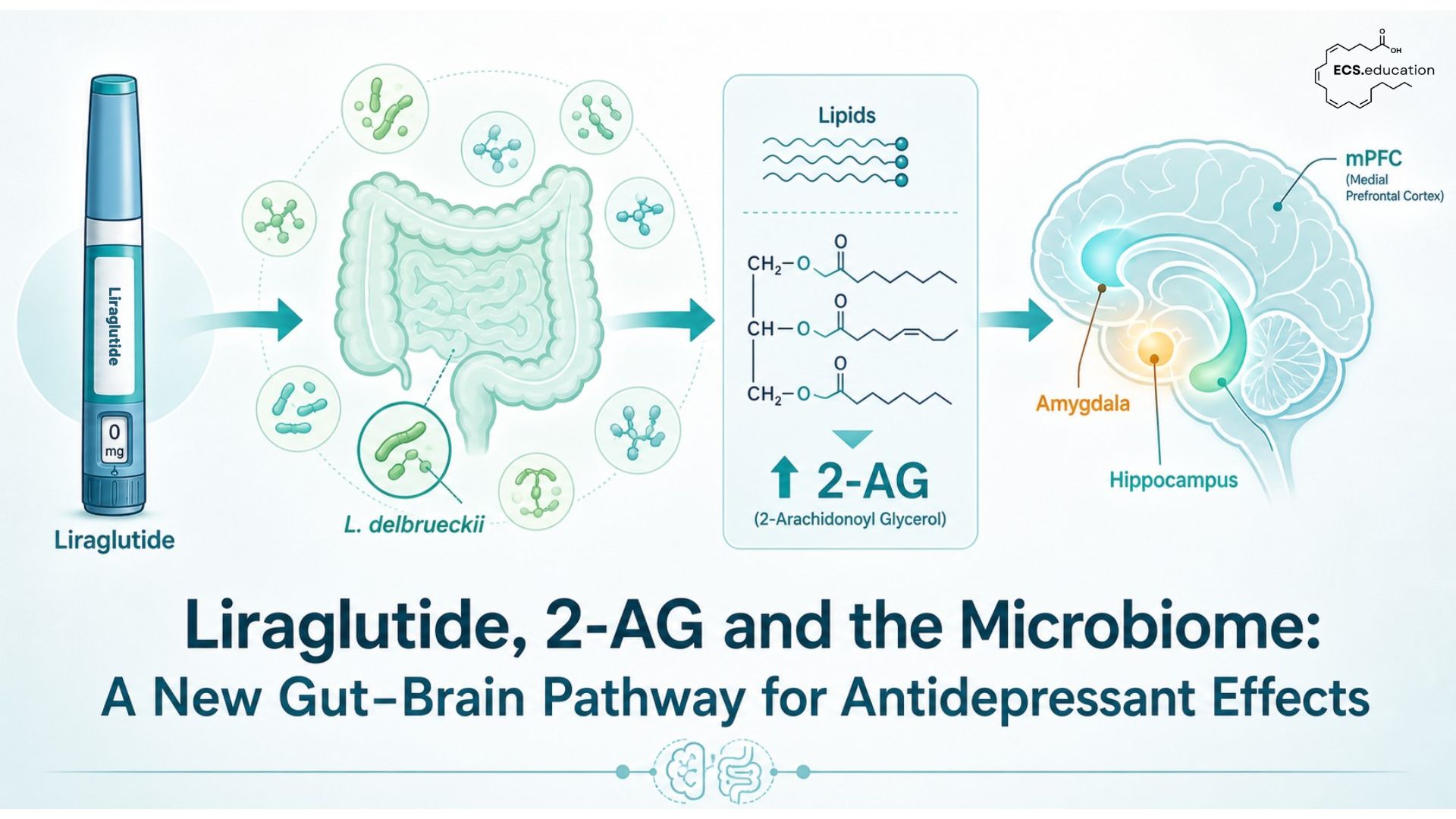
A new paper in Cell Host & Microbe has just delivered one of the most compelling mechanistic stories yet for how the endocannabinoid system (ECS) links metabolic drugs, the gut microbiome, and mood regulation. The study shows that the antidepressant effects of the GLP‑1 analog liraglutide are not driven by classical GLP‑1 receptor signaling in the brain. Instead, they depend on a microbiota‑driven increase in the endocannabinoid 2‑arachidonoylglycerol (2‑AG) that restores healthy activity in emotional processing circuits.
GLP‑1 agonists are now widely used for diabetes and obesity, yet their neuropsychiatric effects remain controversial. In a series of elegant mouse experiments, the authors demonstrate that liraglutide retains full antidepressant‑like efficacy even when GLP‑1 receptors are pharmacologically blocked or genetically deleted. In contrast, when the gut microbiota is depleted with antibiotics, the behavioral benefits disappear completely. Antidepressant‑like effects can then be transferred to naïve animals via fecal microbiota transplantation (FMT) from liraglutide‑treated donors, confirming a causal gut–brain route.
In other words: block GLP‑1 receptors and liraglutide still works for mood; wipe out the microbiome and it stops working. Restore the microbiome and you restore the antidepressant effect.
A single bacterium and a single lipid pathway
Multi‑omics analyses pinpoint a key microbial player: Lactobacillus delbrueckii. Liraglutide increases the abundance of this species in the gut, and colonizing mice with L. delbrueckii alone is sufficient to reproduce the antidepressant‑like phenotype. Mechanistically, L. delbrueckii enriches diacylglycerol (DAG) species that serve as substrates for host 2‑AG synthesis. The result is a restoration of 2‑AG levels that were previously suppressed under chronic stress.
Rather than a vague “gut–brain axis,” the paper offers an explicit substrate‑level chain: liraglutide → microbiota shift → DAG pool → 2‑AG → emotional circuits.
2‑AG as a dimmer switch on emotional circuits
Why does this matter for brain function? 2‑AG is the most abundant endocannabinoid and a full agonist at CB1 receptors densely expressed in the amygdala, medial prefrontal cortex, and hippocampus—regions that form the core of emotional processing networks. In these regions, 2‑AG is synthesized “on demand” at active synapses and travels backwards across the synapse to dampen presynaptic neurotransmitter release. Functionally, it behaves like a dimmer switch on overactive synapses: the more excessive the firing, the stronger the local 2‑AG brake.
Chronic stress, by contrast, has been repeatedly shown to disrupt microbiota composition, deplete endocannabinoid precursors, and lower 2‑AG levels in mood‑relevant circuits, leading to hyperactive amygdala–prefrontal networks and anxiety‑ or depression‑like behavior. The new study shows that elevating 2‑AG via the microbiota normalizes these hyperactive neuronal ensembles in emotional processing circuits and drives the behavioral rescue.
Several nuances are important:
- This is a GLP‑1 receptor–independent mechanism specific to mood‑related endpoints; it does not negate the established GLP‑1R‑mediated metabolic actions of liraglutide on glycemia and body weight.
- The data are preclinical and male‑mouse only, so sex‑specific and human translational studies are urgently needed to map the effect size and boundary conditions in people.
- The identification of L. delbrueckii and DAG–2‑AG metabolism as key nodes immediately suggests more targeted strategies than FMT: rational probiotic design, dietary modulation of lipid precursors, and direct pharmacological support of 2‑AG tone.
Still, the principle stands: when chronic stress drives 2‑AG too low in emotional circuits, a microbiota‑driven restoration of 2‑AG can reset network dynamics and behavior.
A blueprint for microbiota–ECS–brain interventions
For the ECS field, this study is an important milestone. It embeds the endocannabinoid system at the center of a gut–brain pathway through which a mainstream metabolic drug exerts antidepressant‑like effects. It also dovetails with prior evidence that:
- The ECS is a key regulator of energy homeostasis, lipid and glucose metabolism, appetite, and neuroendocrine function.
- Chronic stress disrupts microbiota composition and lowers endocannabinoid tone in mood‑relevant circuits.
- Pharmacological or nutritional interventions that restore 2‑AG signaling produce robust antidepressant and anxiolytic outcomes in preclinical models.
At ECS.education, this is viewed less as an isolated curiosity and more as a blueprint for next‑generation interventions:
- Not “ECS in isolation,” but ECS as the integrating hub where microbiota composition, dietary lipids, pharmacology and brain network dynamics converge to shape mental health.
- Not “probiotics for mood” in the abstract, but precision microbiome engineering around defined lipid pathways (e.g., DAG species that feed 2‑AG synthesis).
- Not “GLP‑1 drugs as incidental mood modifiers,” but deliberate co‑design of metabolic and neuropsychiatric outcomes via ECS‑linked gut–brain routes.
The ECS is not a cannabis system you can opt out of
The broader message is simple but important: the ECS is not a “cannabis system” that clinicians, researchers or educators can choose to ignore. It is a diet‑ and microbiota‑sensitive homeostatic suprasystem that:
- integrates signals from metabolic hormones, dietary lipids and microbial metabolites,
- reshapes neural circuits governing mood, appetite, pain and stress, and
- constantly negotiates balance between energy storage, immune activity and emotional state.
Liraglutide’s 2‑AG‑mediated antidepressant pathway is one concrete example where a mainstream, non‑cannabinoid drug reveals just how central the ECS is to human physiology. As more of these stories accumulate—from obesity and MASLD to pain, sleep, and now mood—it becomes increasingly untenable to treat the ECS as an optional module tacked onto cannabis pharmacology.
For medical education, research design and clinical practice, the implication is clear:
to understand modern metabolic and mental‑health disorders, the ECS must be treated as a core regulatory system with a bidirectional relationship to our microbiome, our diet and our daily habits.
Reference
Bian L, Cai Y, Zhang Y, et al. Microbiota-driven gut-brain signaling underlies antidepressant effects of a GLP-1 analog. Cell Host Microbe. 2026;34(6):1000-1017.e5. doi:10.1016/j.chom.2026.05.003