
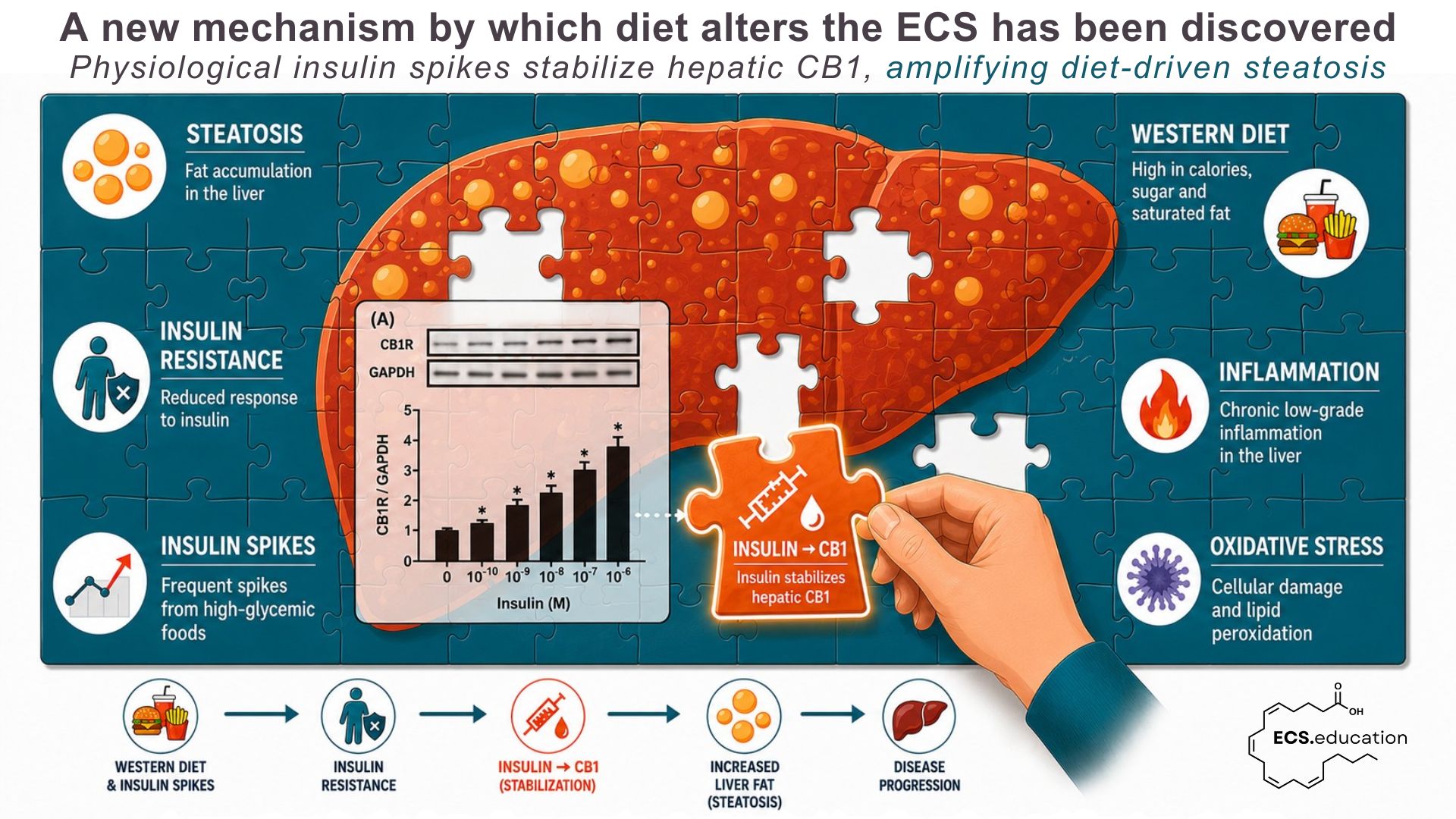
Scientists have just added an important new piece to the diet–ECS story, and it makes our everyday food choices look even more consequential for long‑term health.
For years, we have known that the endocannabinoid system (ECS) is not simply a set of “cannabis receptors.” It is a homeostatic network that helps tissues all over the body balance energy, inflammation, and metabolism. In the periphery, especially in organs like the liver and adipose tissue, more CB1 activity is not better; it is often the opposite. Hepatic CB1 activation promotes de novo lipogenesis, steatosis and insulin resistance, and knocking out CB1 specifically in the liver protects animals from diet‑induced fatty liver and metabolic derangement even when they still gain weight (Osei-Hyiaman et al., 2008).
So far, most of the diet–ECS focus has been on fats. The omega‑6/omega‑3 balance of our diet determines which lipid mediators the ECS can make. High linoleic‑acid intake (the main omega‑6 in seed oils) pushes tissues toward arachidonic‑acid‑derived endocannabinoids like anandamide and 2‑AG, and these levels rise as dietary linoleic acid climbs from about 1% to 8% of energy intake. Adding more EPA and DHA has the opposite effect, shifting the mediator profile toward more resolving, omega‑3‑derived species and normalising endocannabinoid tone (Alvheim et al., 2012).
A new study by Liu and colleagues extends this picture in a crucial way by showing how carbohydrate load feeds into the ECS, not through ligands, but through receptor number in the liver.
Using a gold‑standard in‑vivo insulin model with physiological post‑meal insulin pulses, they examined hepatic CB1. CB1 gene expression barely changed, but CB1 protein increased by about 50% within a few hours. When ERK signalling was blocked, the effect disappeared, and further work showed that insulin was slowing the normal lysosomal degradation of CB1. In other words, a normal‑sized insulin spike was stabilising CB1 receptors, keeping them from being recycled and destroyed.
This means diet now appears to control both sides of the hepatic ECS:
- Fat quality (omega‑6/3 ratio) determines whether the system is dominated by omega‑6‑derived or omega‑3‑derived lipid mediators (Artmann et al., 2008).
- Carbohydrate quality, via the magnitude of the insulin response, determines how many CB1 receptors the liver has available to respond to those mediators. A physiologically sized insulin spike can increase hepatic CB1 protein by roughly 50% in just a few hours by hindering the cell’s normal recycling of the receptor (Liu et al., 2026).
In peripheral tissues like the liver, where CB1 activation drives steatosis and worsens insulin signalling, that combination is bad news: more ligand plus more receptor in an organ that is already central to metabolic disease.
The message is clear. ECS physiology and nutrition research are not separate topics; they are deeply intertwined. The systems biology of the ECS – how diet shapes ligands, receptors, and their downstream pathways over time – is a missing link in understanding how everyday dietary choices translate into non‑communicable diseases like fatty liver, type 2 diabetes and cardiometabolic disease.
References:
Alvheim AR, Malde MK, Osei-Hyiaman D, et al. Dietary linoleic acid elevates endogenous 2-AG and anandamide and induces obesity. Obesity (Silver Spring). 2012;20(10):1984-1994. doi:10.1038/oby.2012.38
Osei-Hyiaman D, Liu J, Zhou L, et al. Hepatic CB1 receptor is required for development of diet-induced steatosis, dyslipidemia, and insulin and leptin resistance in mice. J Clin Invest. 2008;118(9):3160-3169. doi:10.1172/JCI34827
Liu SY, Ting CH, Hwang GS, et al. Insulin increases expression of cannabinoid receptor 1 by suppressing lysosomal degradation via ERK signaling pathway. Int J Med Sci. 2026;23(6):2027-2038. Published 2026 May 1. doi:10.7150/ijms.126308
Artmann A, Petersen G, Hellgren LI, et al. Influence of dietary fatty acids on endocannabinoid and N-acylethanolamine levels in rat brain, liver and small intestine. Biochim Biophys Acta. 2008;1781(4):200-212. doi:10.1016/j.bbalip.2008.01.006
Comment
Comments are closed.