
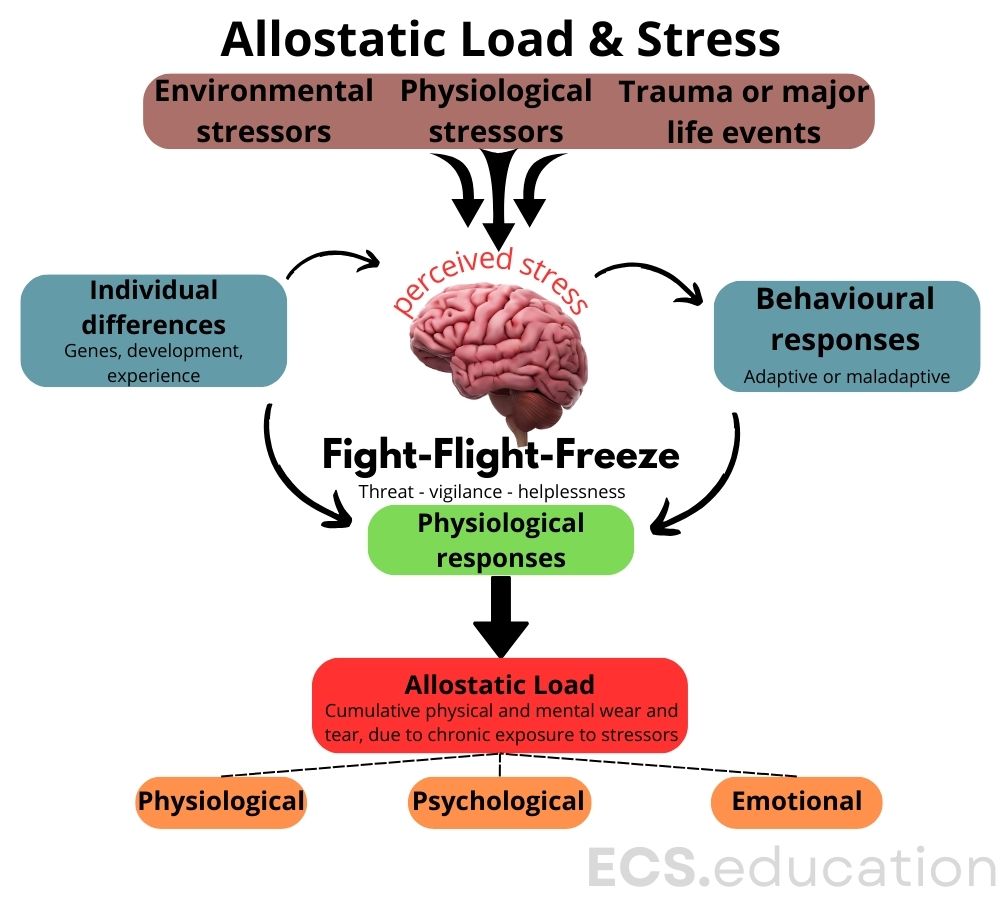
Imagine your body as a sophisticated symphony, with countless instruments playing in perfect harmony. This delicate balance, known as homeostasis, has been the cornerstone of our understanding of human physiology for nearly a century. But what happens when life throws curveballs at this finely tuned orchestra? Enter the concepts of allostasis and allostatic load, and their fascinating interplay with the Endocannabinoid System (ECS).
Homeostasis: The Body’s Baseline
Homeostasis, first described by Walter Cannon in the 1920s, refers to the body’s ability to maintain stable internal conditions despite external changes [1]. Think of it as your body’s built-in thermostat, constantly adjusting to keep everything just right. From body temperature to blood pH, homeostatic mechanisms work tirelessly to keep us in balance.
Allostasis: Adapting to Change
While homeostasis focuses on maintaining stability, allostasis recognizes that sometimes the body needs to change its normal set points to adapt to new situations. This concept, introduced by Sterling and Eyer in 1988, acknowledges that our physiological systems are dynamic and responsive to environmental demands [2].
Allostasis allows our bodies to respond to stressors, whether physical, emotional, or environmental. It’s what enables us to sprint away from danger, stay up late to meet a deadline, or adjust to high altitudes. However, this adaptability comes at a cost.
Allostatic Load: The Price of Adaptation
When these adaptive responses are activated too frequently or for too long, it can lead to wear and tear on the body – a phenomenon known as allostatic load. This accumulation of stress over time can have serious health consequences, increasing the risk of various physical and mental health disorders [3].
Chronic stress, poor sleep, unhealthy diets, and environmental toxins can all contribute to allostatic load. Over time, this can lead to dysregulation of multiple body systems, including the immune, cardiovascular, and nervous systems.
The Endocannabinoid System: Nature’s Stress Manager
This is where the Endocannabinoid System (ECS) takes center stage. Discovered in the early 1990s, the ECS has emerged as a crucial regulator of homeostasis and a key player in managing allostatic load [4].
The ECS consists of endocannabinoids (naturally occurring cannabis-like compounds), their receptors, and the enzymes that create and break them down. This system is involved in regulating a wide range of physiological processes, including mood, appetite, sleep, and pain sensation [5].
Recent research has shown that the ECS plays a vital role in the body’s response to stress and its ability to return to homeostasis. When we experience stress, the ECS is activated, helping to dampen the stress response and restore balance [6].
Interestingly, chronic stress can lead to dysregulation of the ECS, potentially contributing to the development of allostatic load. This suggests that maintaining a healthy ECS could be crucial for managing stress and preventing the negative health outcomes associated with high allostatic load [7].
The ECS: A Potential Target for Stress-Related Disorders
Understanding the role of the ECS in managing homeostasis and allostatic load opens up exciting possibilities for new therapeutic approaches. Researchers are exploring how modulating the ECS could help in treating stress-related disorders, from anxiety and depression to post-traumatic stress disorder [8].
A Breakthrough in Autism Treatment
Recent research has highlighted that Endocannabinoid System (ECS) dysfunction is a core symptom of Autism Spectrum Disorder (ASD), suggesting that targeting the ECS could be a promising approach for ASD treatment [9]. This aligns with our previous discussion on the link between omega-6/omega-3 imbalance and autism, which also impacts ECS function.
A groundbreaking case report published in June 2024 has shed new light on the potential of addressing allostatic load to improve ECS function and overall health in ASD. D’Adamo et al. described the reversal of autism symptoms in dizygotic twins through a personalized approach focusing on lifestyle and environmental modifications [10].
This study effectively utilized the concept of combating allostatic load to enhance ECS health and homeostasis. The researchers employed a multidisciplinary intervention tailored to each twin’s symptoms and lab results, targeting modifiable environmental and lifestyle factors, including dietary interventions that likely impacted the omega-6/omega-3 balance. The dramatic improvements observed in the twins’ autism symptoms highlight the potential of this approach in managing complex neurological conditions and underscore the importance of ECS function in ASD.
Bridging the Knowledge Gap
Despite these exciting developments, the ECS remains conspicuously absent from many medical textbooks and curricula. As we’ve discussed in previous posts, this knowledge gap could be hindering our ability to develop effective treatments for stress-related disorders and other conditions influenced by the ECS.
It’s time for medical education to catch up with the science. By integrating ECS education into medical curricula, we can equip the next generation of healthcare providers with the knowledge they need to leverage this powerful system in promoting health and managing stress-related disorders.
Conclusion: A New Frontier in Health and Medicine
The intricate dance between homeostasis, allostasis, and the Endocannabinoid System underscores the complexity of human physiology. As we continue to unravel these relationships, it becomes increasingly clear that a comprehensive understanding of the ECS is crucial for advancing our approach to stress management and overall health.
The ECS may just be the key to unlocking new strategies for maintaining balance in our increasingly stressful world. From managing everyday stress to potentially reversing symptoms of complex disorders like autism, the implications of ECS research are far-reaching and profound.
Isn’t it time we gave the Endocannabinoid System the attention it deserves in medical education and research? The future of personalized medicine and holistic health may very well depend on it.
References
- Cannon, W. B. (1929). Organization for physiological homeostasis. Physiological Reviews, 9(3), 399-431.
- Sterling, P., & Eyer, J. (1988). Allostasis: A new paradigm to explain arousal pathology. Handbook of life stress, cognition and health.
- McEwen, B. S. (1998). Protective and damaging effects of stress mediators. New England Journal of Medicine, 338(3), 171-179.
- Di Marzo, V., Bifulco, M., & De Petrocellis, L. (2004). The endocannabinoid system and its therapeutic exploitation. Nature Reviews Drug Discovery, 3(9), 771-784.
- Pacher, P., Bátkai, S., & Kunos, G. (2006). The endocannabinoid system as an emerging target of pharmacotherapy. Pharmacological Reviews, 58(3), 389-462.
- Hill, M. N., & Tasker, J. G. (2012). Endocannabinoid signaling, glucocorticoid-mediated negative feedback, and regulation of the hypothalamic-pituitary-adrenal axis. Neuroscience, 204, 5-16.
- Morena, M., Patel, S., Bains, J. S., & Hill, M. N. (2016). Neurobiological interactions between stress and the endocannabinoid system. Neuropsychopharmacology, 41(1), 80-102.
- Patel, S., Hill, M. N., Cheer, J. F., Wotjak, C. T., & Holmes, A. (2017). The endocannabinoid system as a target for novel anxiolytic drugs. Neuroscience & Biobehavioral Reviews, 76, 56-66.
- Zamberletti, E., Gabaglio, M., & Parolaro, D. (2017). The Endocannabinoid System and Autism Spectrum Disorders: Insights from Animal Models. International Journal of Molecular Sciences, 18(9), 1916. https://doi.org/10.3390/ijms18091916
- D’Adamo CR, Nelson JL, Miller SN, Rickert Hong M, Lambert E, Tallman Ruhm H. Reversal of Autism Symptoms among Dizygotic Twins through a Personalized Lifestyle and Environmental Modification Approach: A Case Report and Review of the Literature. J Pers Med. 2024;14(6):641. Published 2024 Jun 15. doi:10.3390/jpm14060641