
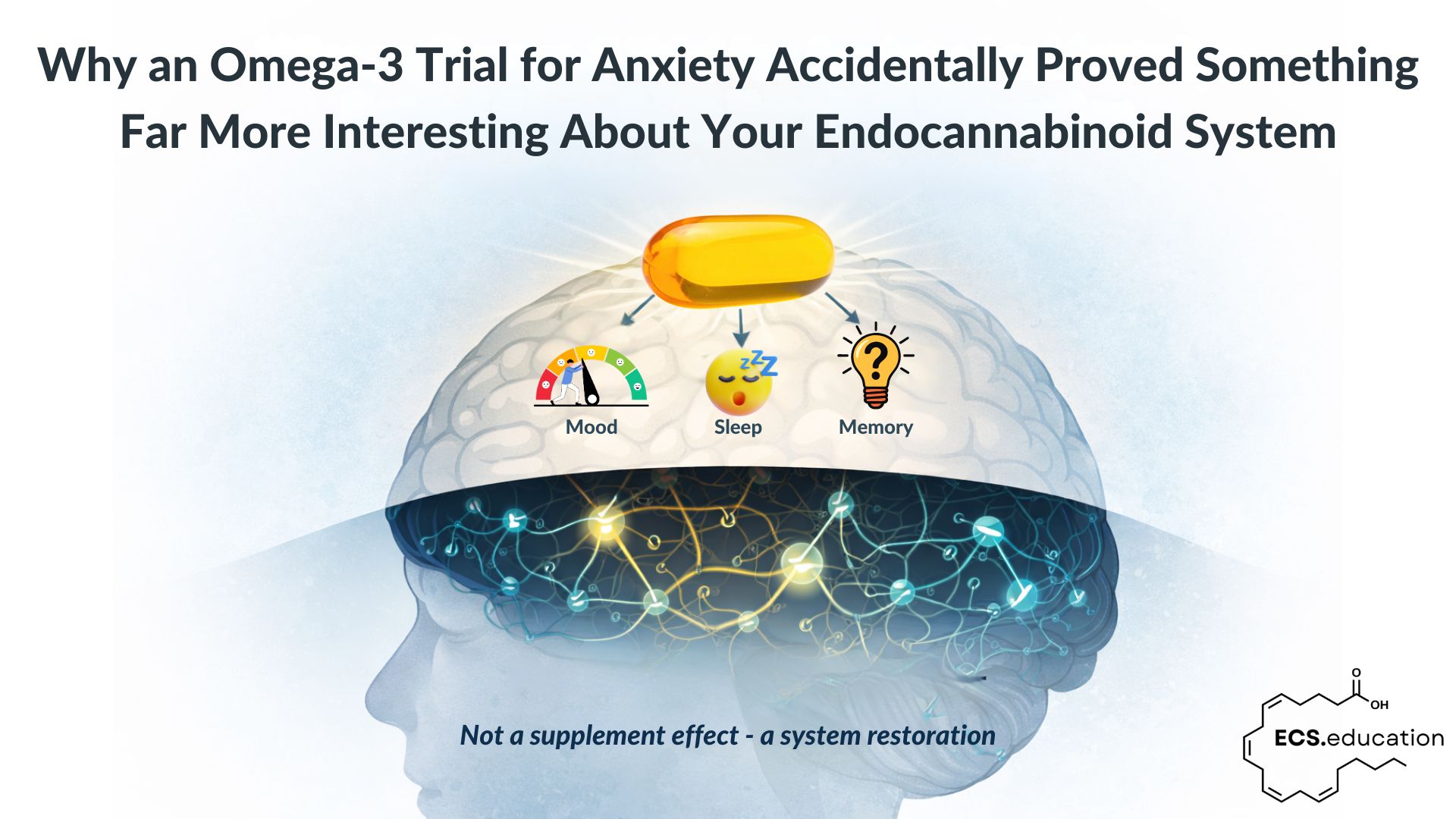
A new randomised, double-blind, placebo-controlled trial published in the Journal of Affective Disorders set out to test whether omega-3 supplementation improves stress, anxiety, depression, sleep quality, and memory in people with severe psychological distress (Azhar et al., 2025). The trial was conducted on a Saudi population, was reasonably well-designed, and produced striking results: stress scores dropped by 52%, anxiety by 43%, depression by 41%, and memory improved by 24%, all relative to a placebo that barely moved.
The authors concluded that omega-3 is “a safe and effective adjunct for managing stress, mood disorders, and sleep disturbances.” Fair enough. But that conclusion misses the more interesting story that the data is actually telling.
Buried inside this dataset is a pattern that, once you understand it, points directly at the endocannabinoid system as the upstream mechanism explaining virtually every finding in the paper. Not just some of them. All of them. The authors had the data to make that argument and didn’t, likely because almost nobody in clinical nutrition research thinks about omega-3 through a CB1 receptor lens. I do, which is why this paper caught my attention.
The Pattern You Need to See First
The trial measured six outcomes. Here are the effect sizes, ranked from largest to smallest:
| Outcome | Cohen’s d |
|---|---|
| Perceived Stress (PSS) | 3.41 |
| Anxiety (GAD-7) | 3.38 |
| Depression (PHQ-9) | 3.12 |
| Everyday Memory (EMQ) | 1.53 |
| Sleep Quality (PSQI) | 0.66 |
| Daytime Sleepiness (ESS) | 0.18 (non-significant) |
That is not a flat “omega-3 improves everything slightly” profile. It is a steep gradient with a hard floor at the bottom. Enormous effects on mood and cognition, a moderate effect on sleep quality, and zero effect on daytime sleepiness. The last outcome did not move at all.
A broadly anti-inflammatory compound acting non-specifically on brain health would not produce this hierarchy. You would expect moderate effects distributed more evenly across the board. The tight clustering of large effects around emotional regulation and memory, the moderate effect on sleep quality, and the complete null on daytime sleepiness are telling you something specific about which brain systems omega-3 is actually working through.
That specificity is the fingerprint of the endocannabinoid system, and I will explain exactly why.
What Omega-3 Does to CB1 Receptors
Most people understand omega-3 fatty acids as anti-inflammatory. That framing is not wrong, but it misses the more fundamental relationship. DHA (docosahexaenoic acid) is the dominant long-chain polyunsaturated fatty acid in brain synaptosomal membranes, and CB1 receptor density, G-protein coupling efficiency, and receptor trafficking are all directly dependent on the lipid environment that DHA creates (Lafourcade et al., 2011).
An analogy helps here. CB1 receptors are not floating in empty space. They are embedded in the neuronal membrane like a protein antenna mounted in a wall. The composition of that wall determines how many antennas can be installed, how freely they can rotate to catch incoming signals, and how efficiently they transmit those signals to the cellular machinery behind them. When the wall is built from DHA-rich phospholipids, conditions are optimal. When dietary DHA is chronically insufficient, the membrane becomes stiffer, and CB1 receptor expression drops.
This has been demonstrated experimentally. A 2024 study in mice found that an omega-3-enriched diet produced roughly a 30% increase in hippocampal CB1 receptor density compared to omega-3-deficient controls, alongside improved LTP and memory performance (Serrano, 2024). A separate study showed that omega-3 supplementation restored CB1 receptor expression in the amygdala, motor cortex, and cingulate cortex following alcohol-induced receptor depletion (Martín-Llorente et al., 2023). These are the brain regions most directly relevant to anxiety, stress reactivity, and emotional regulation.
Omega-3 deficiency, viewed through this lens, is nutritional CB1 downregulation. The mechanism is different from pharmacological downregulation, but the endpoint is the same: fewer functional CB1 receptors per neuron, reduced G-protein coupling, attenuated endocannabinoid signalling.
There is a second layer that makes the relationship even tighter. DHA and EPA are not only structural components of CB1-containing membranes. They are also direct metabolic precursors to a family of omega-3-derived endocannabinoids, including DHEA (docosahexaenoyl ethanolamide) and EPEA (eicosapentaenoyl ethanolamide), which activate CB1 receptors with affinity broadly comparable to anandamide (Meijerink et al., 2015; Balvers et al., 2012). Repletion of omega-3 therefore restores CB1 substrate at two levels simultaneously: receptor expression and endogenous ligand availability (Berger et al., 2001; Lafourcade et al., 2011).
Why Effects Are Largest in Deficient Populations
Before going through each outcome, one principle needs to be established because it runs through everything that follows.
The endocannabinoid system has a physiological ceiling. When CB1 receptor expression is adequate and endogenous ligand tone is sufficient, the system is near that ceiling, and interventions that work through CB1 produce minimal additional benefit. You cannot meaningfully amplify a system already operating at capacity.
When CB1 substrate has been depleted, however, the same intervention that would do nothing in an intact system produces large effects proportional to the severity of the prior depletion. I have been investigating this principle extensively in a pharmacological context, and the pattern is consistent across different routes to CB1 insufficiency.
The trial authors observed this without naming it. They noted that the positive effects of omega-3 are stronger in clinically distressed versus subclinical populations, and that Saudi adults have particularly low baseline omega-3 status, which is associated with stronger treatment responses. That is the substrate-ceiling principle operating in its nutritional form. A population chronically deficient in omega-3 is a population running with chronically depleted CB1 substrate. Repletion produces large effects because the distance from depletion to physiological ceiling is so much greater than in a well-nourished population.
Dissecting Each Outcome
Stress, Anxiety, and Depression
The largest effects in the trial sit here, and that is exactly where you would predict them under an ECS restoration hypothesis. CB1 receptors are most densely expressed in limbic structures: the basolateral amygdala, prefrontal cortex, anterior cingulate cortex, and hippocampus (Mackie, 2005). These are the circuits that process threat, regulate fear extinction, and calibrate the duration and intensity of the stress response.
The endocannabinoid system in these regions functions as a retrograde braking mechanism. When a postsynaptic neuron is driven too hard by stress-related input, it synthesises endocannabinoids on demand, which travel backwards across the synapse and activate CB1 receptors on the presynaptic terminal, reducing further glutamate or GABA release. This is called depolarisation-induced suppression of excitation or inhibition, and it is one of the primary mechanisms by which the brain terminates an acute stress response and prevents it from becoming chronic (Katona and Freund, 2012).
When CB1 substrate is depleted, this braking mechanism weakens. The amygdala fires without adequate retrograde inhibitory feedback. The prefrontal cortex loses part of its capacity to suppress amygdala reactivity. Fear extinction, which depends on CB1-mediated LTP in the infralimbic cortex, becomes impaired. CB1 knockout mice show precisely this phenotype: exaggerated HPA axis responses to stress, impaired fear extinction, and persistent anxiety-like behaviour that does not resolve without pharmacological intervention (Marsicano et al., 2002).
The d values of 3.12 to 3.41 observed here are not simply “omega-3 makes people feel better.” They reflect the restoration of an entire neuromodulatory system in a population that had been running in a state of nutritional CB1 insufficiency, in the circuits where CB1 density is highest and the functional consequences of its absence are most severe.
Memory
The hippocampus has among the highest CB1 receptor density in the brain, concentrated particularly in the perforant path input to CA1 and the mossy fibre pathway from the dentate gyrus (Mackie, 2005). CB1-mediated modulation of synaptic plasticity at these synapses is directly relevant to episodic and everyday memory encoding, not as a secondary effect but as a primary mechanism (Serrano et al., 2024).
The 2024 mouse study mentioned earlier found that omega-3 feeding restored CB1-dependent LTP in the hippocampal perforant pathway and improved performance on novel object recognition, a standard memory task. The 25% improvement in everyday memory (EMQ) in this trial is consistent with that mechanism operating in a human population with depleted hippocampal CB1 substrate. The effect size of d = 1.53 is smaller than the limbic mood effects, which makes sense: hippocampal CB1 density is high, but the amygdala and PFC circuits governing stress and anxiety are even more densely CB1-expressed, placing the recovery ceiling higher in those domains.
Sleep Quality
Sleep quality, measured by the PSQI, improved significantly with an effect size of d = 0.66, roughly one-fifth of the anxiety effect. That disproportion is worth thinking through carefully rather than treating the sleep result as simply a smaller version of the mood result.
The PSQI is a composite scale. It captures sleep latency, total sleep duration, efficiency, fragmentation, subjective quality, daytime dysfunction, and use of sleep medication. Some of these dimensions are genuinely CB1-sensitive. CB1 receptors in thalamocortical circuits and brainstem sleep-generating nuclei, including the pedunculopontine tegmentum and basal forebrain, regulate REM generation, sleep state stability, and the coupling between slow oscillations and faster sleep rhythms (Prospero-Garcia et al., 2016). Restoring CB1 substrate in these circuits plausibly improves sleep fragmentation, REM continuity, and subjective sleep quality.
But other PSQI dimensions, particularly total sleep duration and sleep onset latency, are primarily regulated by adenosinergic sleep pressure and circadian timing. Omega-3 and CB1 signalling do not substantially govern those processes. The moderate PSQI effect reflects genuine CB1-mediated improvement in sleep architecture quality, diluted by subscales that measure sleep drive dimensions the ECS does not directly control. A d of 0.66 on PSQI is not a weak result in this context. It is the right-sized result for a CB1-specific intervention acting on a composite scale with mixed CB1-sensitivity.
Daytime Sleepiness: The Most Informative Null Result in the Paper
The Epworth Sleepiness Scale produced d = 0.18, p = 0.47. That is not a marginal effect that failed significance. That is a flat null.
The authors explained this away with references to ESS measuring “trait-level sleepiness” and the confounding influence of caffeine and electronic devices. Those explanations are not mechanistic. They are the kind of thing you write when you do not have a clear account of why your intervention failed to move an outcome.
The actual explanation is simpler and more informative. The ESS measures one thing above all else: the propensity to fall asleep passively during the day. What determines that propensity is the balance between two systems that have nothing to do with CB1.
The first is adenosine, the homeostatic sleep pressure molecule that accumulates during wakefulness as a byproduct of neural ATP consumption and dissipates during sleep. Adenosine builds pressure on the brain’s sleep-promoting circuits through A1 and A2A receptors concentrated in the basal forebrain and striatum. This is the system caffeine works on, blocking adenosine receptors to maintain alertness (Porkka-Heiskanen et al., 1997).
The second is orexin (hypocretin), produced by a small population of lateral hypothalamic neurons that fire throughout wakefulness to stabilise arousal by suppressing sleep circuits and maintaining the competitive dominance of the wake state (Saper et al., 2010). Orexin neuron loss is the direct cause of narcolepsy type 1, characterised by pathological daytime sleep intrusions that are, in the extreme, the most severe form of ESS elevation possible.
Neither adenosine signalling nor orexin neuron function is meaningfully regulated by CB1 receptor density or by omega-3 fatty acid status. The orexin system responds to circadian signals, metabolic cues, and emotional arousal, but its activity does not track the ECS. Adenosine accumulation is a function of sleep-wake history and neural metabolic activity, not endocannabinoid tone.
So when omega-3 restores CB1 substrate and dramatically improves anxiety, depression, memory, and sleep architecture quality while leaving ESS completely unchanged, it is not failing to do something it should do. It is succeeding with precision at exactly what CB1 restoration should accomplish, and leaving untouched the systems it has no reason to affect.
The ESS null is the strongest piece of evidence in the entire paper for a CB1-specific mechanism, precisely because it rules out a non-specific explanation. A broadly neuroprotective or anti-inflammatory intervention would improve restorative sleep, which would improve daytime alertness, which would move the ESS at least modestly. A CB1-specific substrate restoration leaves the adenosine/orexin arousal architecture completely intact. That is what happened here.
Putting It Together: ECS Hypofunction as the Upstream Condition
The population enrolled in this trial presented with severe anxiety, stress, depression, memory impairment, and poor sleep quality. That symptom cluster has a name in the endocannabinoid literature: ECS hypofunction. It is the state in which CB1 receptor availability and endogenous ligand tone are insufficient to perform the system’s homeostatic roles across limbic, hippocampal, and thalamocortical circuits (Russo, 2016).
The causal chain in this specific population runs as follows. Saudi adults have chronically low omega-3 intake by documented dietary survey (Azhar et al., 2023). Chronic omega-3 deficiency reduces neuronal membrane DHA, which reduces CB1 receptor density and G-protein coupling efficiency in proportion to the degree of deficiency (Lafourcade et al., 2011; Serrano, 2024). Reduced limbic CB1 impairs retrograde inhibition of stress circuits, producing anxiety, chronic stress, and mood dysregulation. Reduced hippocampal CB1 impairs synaptic plasticity and memory encoding. Reduced CB1 tone in sleep-regulating circuits degrades sleep architecture quality, which registers as a worse PSQI score. Adenosine and orexin arousal circuits, which do not depend on CB1, remain functional, so ESS does not change. Omega-3 repletion reverses this by restoring membrane DHA, recovering CB1 expression and endogenous ligand supply, and allowing the ECS to resume its homeostatic functions (Berger et al., 2001; Meijerink et al., 2015). All CB1-dependent symptoms improve in proportion to how depleted the substrate was to begin with.
The effect sizes in each domain scale with CB1 receptor density in the relevant circuit, highest in limbic structures, moderate in hippocampal and sleep-regulating circuits, negligible in adenosine/orexin pathways. That gradient is the argument.
What the Authors Missed, and What Should Come Next
The authors attributed the sleep improvement to omega-3’s influence on serotonin synthesis and melatonin production. Those mechanisms are real but downstream of the ECS, and they do not survive the ESS test. Serotonin is involved in both sleep architecture and waking arousal maintenance, so a serotonin-mediated improvement in sleep would be expected to produce at least some movement on the ESS. It did not move. The serotonin explanation cannot account for the pattern of selective improvement across CB1-sensitive outcomes with a concurrent null on an adenosine/orexin-dependent measure.
What would properly confirm the ECS hypothesis in a future trial is straightforward: measure plasma anandamide and 2-AG at baseline and post-intervention to verify that endocannabinoid tone tracks the clinical improvement, measure baseline omega-3 index to confirm rather than assume the deficiency starting point, and move beyond self-report sleep questionnaires to objective physiological sleep measurement.
The Broader Point
This trial enrolled people who were anxious, depressed, stressed, forgetful, and sleeping badly. That is a very common clinical presentation, and omega-3 supplementation resolved it with effect sizes that are, frankly, embarrassing for many approved pharmaceuticals.
The framing that emerged from the paper was nutritional: omega-3 as a supplement for psychological distress. The framing that emerges from the data, read carefully, is mechanistic: a population with a nutritionally depleted endocannabinoid system was given the raw material to rebuild it, and the symptoms of ECS hypofunction resolved accordingly.
The endocannabinoid system modulates the gain of stress circuits, threat appraisal, memory consolidation, and sleep architecture simultaneously, which is why its dysfunction presents as a cluster rather than a single symptom, and why its restoration produces effects across all of those domains at once. That is not what vitamin supplements typically do, and it is not coincidence that a nutrient with the specific biochemical relationship to CB1 receptors that omega-3 has would produce precisely this profile.
The omega-3 capsule in this trial was not a stress supplement. For these patients, it was CB1 substrate repletion therapy. The field simply has not developed the vocabulary to say so yet.
The kind of ECS literacy this post draws on is rare in clinical and industry settings, and that gap is increasingly costly as ECS therapeutics mature as a field. If your research or your pipeline could benefit from a rigorous, mechanistically grounded understanding of ECS physiology and pharmacology, I am genuinely interested in talking. That includes academic collaborators working on ECS-adjacent questions and pharma or biotech teams navigating cannabinoid pharmacology without a clear framework for receptor monitoring. Reach me at stefan[at]ecs.education.
References
Azhar W, Qadhi A, Abusudah W, et al. The effects of Omega-3 supplementation on stress, anxiety, depression, sleep quality, and everyday memory in individuals with psychological distress: A randomized, double-blind, placebo-controlled trial. J Affect Disord. 2026;399:121055. doi:10.1016/j.jad.2025.121055
Azhar W, Al-Otaibi K, Abusudah WF, et al. The consumption of dietary supplements in Saudi Arabia during the COVID-19 pandemic: A cross-sectional study. Saudi Pharm J. 2023;31(10):101779. doi:10.1016/j.jsps.2023.101779
Balvers MG, Verhoeckx KC, Plastina P, Wortelboer HM, Meijerink J, Witkamp RF. Docosahexaenoic acid and eicosapentaenoic acid are converted by 3T3-L1 adipocytes to N-acyl ethanolamines with anti-inflammatory properties. Biochim Biophys Acta. 2010;1801(10):1107-1114. doi:10.1016/j.bbalip.2010.06.006
Berger A, Crozier G, Bisogno T, Cavaliere P, Innis S, Di Marzo V. Anandamide and diet: inclusion of dietary arachidonate and docosahexaenoate leads to increased brain levels of the corresponding N-acylethanolamines in piglets. Proc Natl Acad Sci U S A. 2001;98(11):6402-6406. doi:10.1073/pnas.101119098
Katona I, Freund TF. Multiple functions of endocannabinoid signaling in the brain. Annu Rev Neurosci. 2012;35:529-558. doi:10.1146/annurev-neuro-062111-150420
Lafourcade M, Larrieu T, Mato S, et al. Nutritional omega-3 deficiency abolishes endocannabinoid-mediated neuronal functions. Nat Neurosci. 2011;14(3):345-350. doi:10.1038/nn.2736
Mackie K. Distribution of cannabinoid receptors in the central and peripheral nervous system. Handb Exp Pharmacol. 2005;(168):299-325. doi:10.1007/3-540-26573-2_10
Marsicano G, Wotjak CT, Azad SC, et al. The endogenous cannabinoid system controls extinction of aversive memories. Nature. 2002;418(6897):530-534. doi:10.1038/nature00839
Martín-Llorente A, Serrano M, Bonilla-Del Río I, et al. Omega-3 Recovers Cannabinoid 1 Receptor Expression in the Adult Mouse Brain after Adolescent Binge Drinking. Int J Mol Sci. 2023;24(24):17316. Published 2023 Dec 10. doi:10.3390/ijms242417316
Meijerink J, Poland M, Balvers MG, et al. Inhibition of COX-2-mediated eicosanoid production plays a major role in the anti-inflammatory effects of the endocannabinoid N-docosahexaenoylethanolamine (DHEA) in macrophages. Br J Pharmacol. 2015;172(1):24-37. doi:10.1111/bph.12747
Porkka-Heiskanen T, Strecker RE, Thakkar M, Bjorkum AA, Greene RW, McCarley RW. Adenosine: a mediator of the sleep-inducing effects of prolonged wakefulness. Science. 1997;276(5316):1265-1268. doi:10.1126/science.276.5316.1265
Prospéro-García O, Amancio-Belmont O, Becerril Meléndez AL, Ruiz-Contreras AE, Méndez-Díaz M. Endocannabinoids and sleep. Neurosci Biobehav Rev. 2016;71:671-679. doi:10.1016/j.neubiorev.2016.10.005
Russo EB. Clinical Endocannabinoid Deficiency Reconsidered: Current Research Supports the Theory in Migraine, Fibromyalgia, Irritable Bowel, and Other Treatment-Resistant Syndromes. Cannabis Cannabinoid Res. 2016;1(1):154-165. Published 2016 Jul 1. doi:10.1089/can.2016.0009
Saper CB, Scammell TE, Lu J. Hypothalamic regulation of sleep and circadian rhythms. Nature. 2005;437(7063):1257-1263. doi:10.1038/nature04284
Saper CB, Fuller PM, Pedersen NP, Lu J, Scammell TE. Sleep state switching. Neuron. 2010;68(6):1023-1042. doi:10.1016/j.neuron.2010.11.032
Serrano M, Saumell-Esnaola M, Ocerin G, et al. Impact of Omega-3 on Endocannabinoid System Expression and Function, Enhancing Cognition and Behavior in Male Mice. Nutrients. 2024;16(24):4344. Published 2024 Dec 17. doi:10.3390/nu16244344