
A follow-up to “CB1 Availability as a Non-Invasive Biomarker: Bridging Endocannabinoid System Dysfunction and Therapeutic Monitoring“
The Emerging Evidence: Tolerance is Real and Quantifiable
A recent study published in Frontiers in Pharmacology (2025) provided the first systematic measurement of how tolerance accumulates during medical cannabis treatment (Stith et al., 2025). Using real-world data from over 16,000 medical cannabis patients tracking their symptom relief across thousands of cannabis sessions, researchers documented something clinicians have observed anecdotally for years: with each successive cannabis use session, patients experience a measurable decline in therapeutic benefit.
The numbers are sobering. On average, patients experienced a 0.5% decrease in symptom relief with each subsequent session (Stith et al., 2025). While a single session’s decrease appears negligible, the cumulative effect is clinically significant: a patient could expect a 5% reduction in efficacy after just 10 sessions, and a 10% reduction after 20 sessions. For someone using medical cannabis daily to manage chronic pain, anxiety, or depression, this erosion of therapeutic utility occurs within weeks—not months or years (Stith et al., 2025).

What’s particularly striking is that this tolerance effect appeared consistent across all three major symptom categories studied: pain, depression, and anxiety-related conditions. The mechanism driving this tolerance, at least in part, involves a fundamental neurobiological process: the downregulation of CB1 receptors.
The Mechanism: CB1 Downregulation and Its Timeline
In our previous post, we introduced the CB1 receptor as a central hub in the endocannabinoid system’s regulatory function. CB1 receptors are primarily located on the surface of neurons, where they respond to both externally administered cannabinoids (like THC from cannabis) and endogenous cannabinoids produced by the body itself. But chronic daily exposure to high concentrations of THC creates a homeostatic crisis for the nervous system.
When CB1 receptors are continuously stimulated—flooded, essentially—by daily THC agonism, the brain responds by downregulating these receptors. This manifests in two ways: desensitization (reduced responsiveness of existing receptors to cannabinoid binding) and downregulation (actual reduction in receptor density and removal of receptors from the neuronal cell surface). Research using PET neuroimaging has demonstrated that chronic daily cannabis users display approximately 20% lower CB1 receptor availability compared to non-users, with this reduction concentrated in cortical regions like the prefrontal cortex and hippocampus (Hirvonen et al., 2012).
The critical finding, however, is that this process is reversible. PET imaging studies tracking CB1 receptor recovery after abstinence show a predictable timeline (Hirvonen et al., 2012; D’Souza et al., 2016):
- Within 48 hours of stopping cannabis use, initial desensitization reversal begins
- After 7-10 days, noticeable improvement in receptor sensitivity occurs
- After 28 days, CB1 receptor density returns substantially toward baseline levels (Hirvonen et al., 2012)

This reversibility is both encouraging and clarifying for medical cannabis patients. The problem isn’t permanent—but it does require active management.
The Clinical Dilemma: Efficacy vs. Receptor Availability
Here’s where the medical cannabis patient faces a genuine paradox. The Stith et al. data reveals that maintaining symptom relief over the long term requires either:
- Increasing THC potency (approximately 4.4 percentage points per session to offset tolerance) (Stith et al., 2025)
- Increasing dose volume (approximately 6% more per session to maintain efficacy) (Stith et al., 2025)
Yet in the real world, the study found that patients typically only increase their dose by about 0.6% per session—less than one-tenth of what would be needed to maintain therapeutic parity. Moreover, patients rarely switched to higher-potency products, instead accepting declining efficacy as an inevitable consequence of continued treatment (Stith et al., 2025).
This acceptance is problematic for several reasons. First, higher THC exposure creates a dose-response escalation spiral, where patients continuously chase therapeutic relief with increasingly concentrated products. Second—and this is crucial—the very interventions that restore short-term symptom relief (higher THC, higher doses) accelerate CB1 receptor downregulation (Colizzi & Bhattacharyya, 2018), creating a vicious cycle of tolerance deepening.
The research also revealed an interesting silver lining. As tolerance developed and symptom relief diminished, patients reported fewer negative side effects. The tolerance that erodes therapeutic benefit also reduces anxiety, paranoia, dizziness, and other THC-related adverse effects (Stith et al., 2025). But this trades long-term clinical efficacy for a more tolerable side-effect profile—a poor bargain for patients seeking durable symptom management.
A Protective Paradox: Why Chronic Users Drive Better Than Occasional Users
Yet there’s a more profound and clinically actionable silver lining that deserves emphasis. While tolerance reduces therapeutic symptom relief, CB1 receptor downregulation in chronic users paradoxically protects them from a major source of THC-induced impairment: cognitive dysfunction.
This is fundamentally different from merely reducing side effects like dizziness or anxiety. Occasional cannabis users experience measurable deficits in attention, working memory, divided attention, reaction time, and psychomotor coordination—the very cognitive domains essential for safe driving and occupational function (Ramaekers et al., 2009). Research consistently shows these impairments are dose-dependent and directly correlate with acute THC concentrations in blood. Occasional users demonstrate clear impairment across standardized neurocognitive tests that predict driving performance (Ramaekers et al., 2009; Hartman & Huestis, 2013).
Chronic heavy users, by contrast, show no such impairment on these same cognitive tests despite higher THC exposure history, because their downregulated CB1 receptors, particularly in the cortex and prefrontal circuits, are less responsive to THC’s impairing effects. The brain has adapted. The THC-adapted brain can process the same cannabinoid signals that would devastate the cognitive function of an occasional user (Ramaekers et al., 2009). This neuroadaptation occurs through multiple mechanisms, including CB1 receptor internalization and desensitization (Hsieh et al., 1999), as well as reduced responsiveness of reward circuitry that normally mediates acute THC effects on cognition (Mason et al., 2021).
Recent large-scale driving simulator research explicitly documents this protective effect. In the largest such study to date, researchers at UC San Diego Center for Medicinal Cannabis Research found that frequent cannabis users (including those consuming an average of four joints per day) showed no driving impairment after 48 hours of abstinence, performing identically to non-cannabis-using controls on comprehensive driving tasks (Mastropietro et al., 2024). In stark contrast, occasional users with much lower historical THC exposure display measurable driving deficits after acute use (Ramaekers et al., 2009; Hartman & Huestis, 2013).
So what does this mean clinically?
A medical cannabis patient maintaining steady CB1 downregulation from consistent treatment is neurobiologically protected from the acute cognitive impairments that would incapacitate an occasional user receiving the same THC exposure.
The medical cannabis patient can operate a vehicle safely, engage in complex cognitive tasks, maintain employment, and perform high-stakes occupational functions in ways that an individual with intact, responsive CB1 receptors simply cannot tolerate after equivalent THC use (Ramaekers et al., 2009, 2011).
This is not a trivial clinical consideration. For working adults managing chronic pain, anxiety, or other conditions with medical cannabis, CB1 downregulation enables occupational and behavioral function that would otherwise be impossible. Yet this benefit creates an uncomfortable catch-22: the moment that patient reduces their THC exposure (via dose reduction, product switching, or tolerance breaks), their CB1 receptors begin to recover—and so does their susceptibility to cognitive impairment (Hirvonen et al., 2012). A patient might reduce their cannabis use to restore therapeutic efficacy, only to discover they’ve simultaneously increased their vulnerability to impairment during acute dosing.
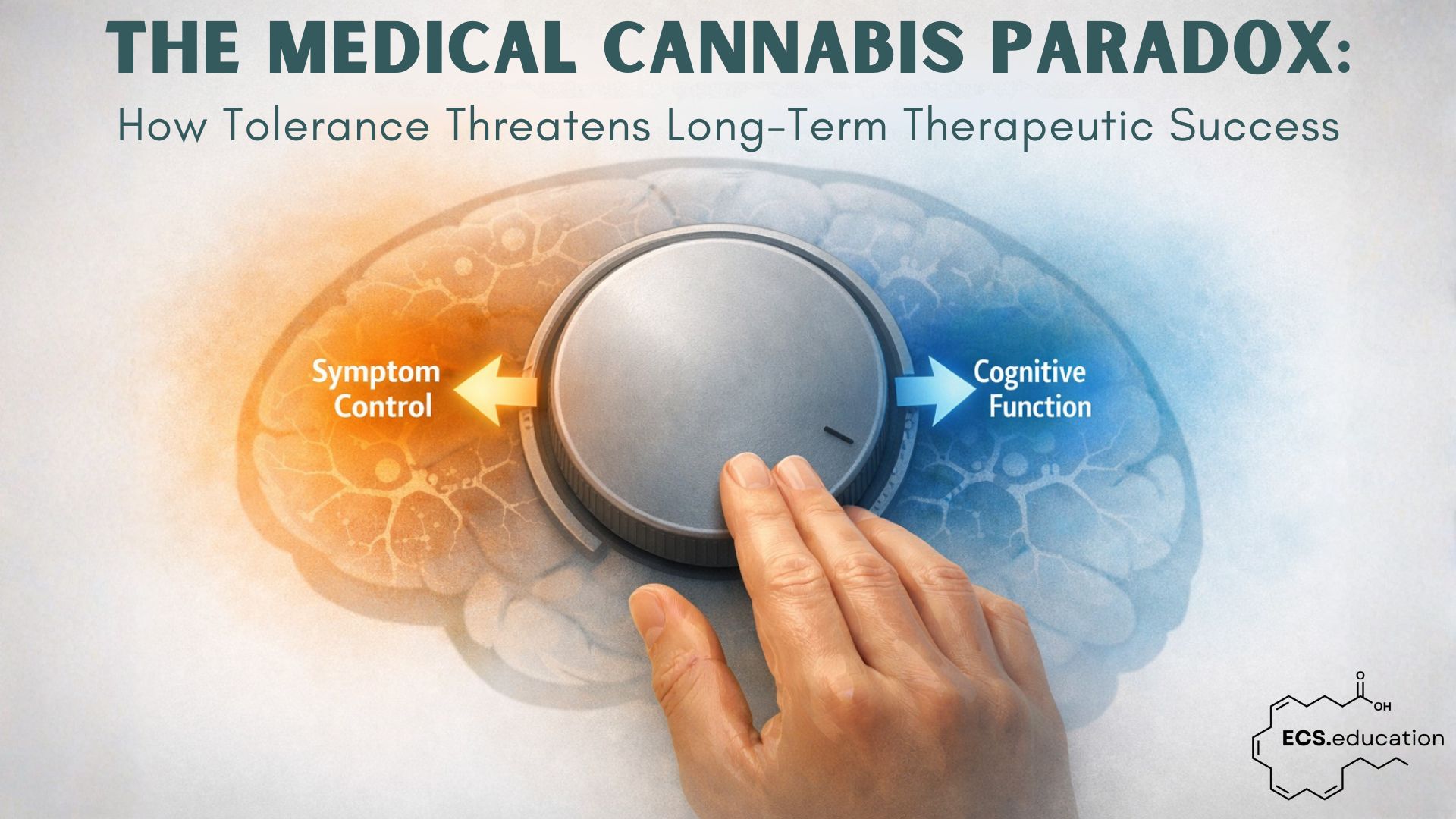
This creates a counterintuitive clinical reality: the very tolerance that erodes therapeutic efficacy is what permits safe, cognitively-intact functioning in high-stakes behavioral contexts. Tolerance management is not merely about preserving symptom relief—it’s about balancing two competing needs: therapeutic efficacy and cognitive safety.
The Missing Piece: Objective Monitoring
Here’s the critical insight that connects back to our previous discussion of CB1 biomarkers: most patients are managing this invisible balance completely blind. They don’t know their actual CB1 receptor status. They don’t know whether their tolerance is at a level that provides adequate cognitive protection while maintaining therapeutic benefit, or whether their current regimen has compromised one or both. They don’t know if their tolerance management strategies are optimizing both therapeutic efficacy and cognitive protection. They’re making million-dollar adjustments using penny-slot guidance.
This is where a non-invasive biomarker for CB1 receptor availability becomes not merely intellectually interesting, but clinically essential. Imagine if a long-term medical cannabis patient could objectively know:
- Whether their current CB1 receptor density has dropped below therapeutic thresholds
- Whether their current CB1 downregulation level provides adequate cognitive protection for their occupational demands
- Whether their rotation and dosing strategies are actually preserving receptor availability while maintaining efficacy
- Whether they should initiate a tolerance reset break and for how long
- When their receptors have recovered enough to safely resume therapeutic dosing (informed by the established 28-day CB1 recovery timeline documented in PET studies) (Hirvonen et al., 2012; D’Souza et al., 2016)
- Whether their individual genetics or physiology is driving faster downregulation than typical
With such biomarker data, the clinical management of cannabis tolerance shifts from reactive (“I’m not feeling relief anymore—I guess I need more cannabis” or “I’m concerned about my ability to drive—should I stop entirely?”) to proactive (“My CB1 availability is declining; let me optimize my consumption pattern now to maintain therapeutic efficacy while preserving cognitive safety”).
The evidence demonstrates that tolerance is mathematically predictable (0.5% per session) and neurobiologically grounded in CB1 receptor adaptation (Stith et al., 2025; Colizzi & Bhattacharyya, 2018). That same predictability means it’s potentially manageable—but only if patients have real-time data about the biological system they’re trying to protect.
The Path Forward: From Reactive to Precision Dosing
Long-term medical cannabis use, the evidence now shows, is not a stable state. It’s a dynamic system requiring continuous calibration. The question for cannabis medicine moving forward is whether that calibration will continue to be guided by subjective symptom reporting alone, with patients flying blind regarding both efficacy and cognitive safety—or whether objective biomarkers of CB1 receptor status will finally enable the precision dosing and patient-specific protocols that medical cannabinoid therapy deserves.
The medical cannabis patient’s true dilemma isn’t simply maintaining symptom relief. It’s maintaining therapeutic efficacy while protecting the very cognitive function that THC-induced CB1 downregulation preserves. Data-driven CB1 monitoring transforms this dilemma from an unsolvable puzzle into a manageable optimization problem.
Key Takeaways
- Cannabis tolerance reflects measurable CB1 receptor downregulation, a reversible but progressive neurobiological adaptation (Hirvonen et al., 2012; Stith et al., 2025)
- While tolerance erodes symptom relief, CB1 downregulation paradoxically protects chronic users from the cognitive impairment that acutely disables occasional users (Ramaekers et al., 2009, 2011; Mason et al., 2021)
- Medical cannabis patients maintaining adequate CB1 downregulation can drive and perform complex cognitive tasks safely—a protection that vanishes if tolerance is reduced too aggressively (Mastropietro et al., 2024; Ramaekers et al., 2009)
- Current medical cannabis protocols cannot distinguish between “I need more cannabis for symptom relief” and “I need to be careful about cognitive safety” and “My CB1 availability is at an optimal level”
- Tolerance management strategies exist but are difficult to implement and verify without objective biomarker data (Stith et al., 2025)
- Non-invasive CB1 availability biomarkers could enable data-driven decisions about product rotation, dosing intervals, and tolerance reset timing—optimizing for both efficacy and safety
- The future of sustainable medical cannabis treatment lies in bridging subjective symptom monitoring with objective endocannabinoid system assessment
Interested in CB1 Biomarker Development?
The clinical need for non-invasive CB1 receptor availability biomarkers is clear and growing urgent. As this research demonstrates, medical cannabis patients face an impossible choice without objective endocannabinoid system data: optimize for symptom relief or cognitive safety, but not both. The future of precision cannabis medicine depends on bridging this gap.
If you are a researcher, clinician, medical device developer, investor, or institution interested in advancing non-invasive biomarker technology for CB1 assessment, we invite you to engage with ECS.education. We are actively seeking:
- Research collaborators in neuroscience and endocannabinoid system biology
- Clinical partners for biomarker validation and real-world testing protocols
- Investment partners interested in the commercial potential of precision cannabis dosing tools
- Healthcare system partnerships for implementation and clinical integration
The convergence of growing medical cannabis adoption, documented tolerance mechanisms, and the established clinical need for objective monitoring represents a significant market and public health opportunity. Non-invasive CB1 biomarkers will become standard of care in cannabis medicine—the question is who will lead that transition.
Contact ECS.education to explore partnership opportunities, research collaborations, or investment participation in advancing endocannabinoid system assessment technology.
References
Colizzi, M., & Bhattacharyya, S. (2018). Cannabis use and the development of tolerance: a systematic review of human evidence. Neuroscience & Biobehavioral Reviews, 93, 1–25. https://doi.org/10.1016/j.neubiorev.2018.07.014
D’Souza, D. C., Cortes-Briones, J. A., Ranganathan, M., Thurnauer, H., Creatura, G., Surti, T., … & Skosnik, P. D. (2016). Rapid changes in CB1 receptor availability in cannabis dependent males after abstinence from cannabis. Biological Psychiatry: Cognitive Neuroscience and Neuroimaging, 1(1), 60–67. https://doi.org/10.1016/j.bpsc.2015.09.008
Hartman, R. L., & Huestis, M. A. (2013). Cannabis effects on driving skills. Clinical Chemistry, 59(3), 478–492. https://doi.org/10.1373/clinchem.2012.194381
Hirvonen, J., Goodwin, R. S., Li, C. T., Terry, G. E., Zoghbi, S. S., Morse, C., … & Innis, R. B. (2012). Reversible and regionally selective downregulation of brain cannabinoid CB1 receptors in chronic daily cannabis smokers. Molecular Psychiatry, 17(6), 642–649. https://doi.org/10.1038/mp.2011.82
Hsieh, C., Brown, S., Derleth, C., & Mackie, K. (1999). Internalization and recycling of the CB1 cannabinoid receptor. Journal of Neurochemistry, 73(2), 493–501. https://doi.org/10.1046/j.1471-4159.1999.0730493.x
Mason, N. L., Kuypers, K. P., Müller, F., Reckweg, J., Terstege, D. J., Cabo da Costa, J. M., … & Ramaekers, J. G. (2021). Reduced responsiveness of the reward system underlies tolerance and increased impulsivity in long-term cannabis users. Addiction Biology, 26(2), e12870. https://doi.org/10.1111/adb.12870
Mastropietro, K., Omidi, L., Tully, J., Walther, S., Marcotte, T. D., & CMCR (2024). Relationship between cannabis use and driving performance after abstinence. JAMA Network Open, 7(9), e2434803. https://doi.org/10.1001/jamanetworkopen.2024.34803
Ramaekers, J. G., Kauert, G., van Ruitenbeek, P., Theunissen, E. L., Schneider, E., & Moeller, M. R. (2009). Neurocognitive performance during acute THC intoxication in heavy and occasional cannabis users. Journal of Psychopharmacology, 23(3), 266–277. https://doi.org/10.1177/0269881108092393
Ramaekers, J. G., Theunissen, E. L., de Brouwer, M., Toennes, S. W., Moeller, M. R., & Kuypers, K. P. (2011). Tolerance and cross-tolerance to neurocognitive effects of THC and alcohol in heavy cannabis users. Psychopharmacology, 214(2), 391–401. https://doi.org/10.1007/s00213-010-1911-4
Stith, S. S., Li, X., Brockelman, F., Keeling, K., Hall, B., & Vigil, J. M. (2025). Cannabis tolerance reduces symptom relief. Frontiers in Pharmacology, 16, 1496232. https://doi.org/10.3389/fphar.2025.1496232