
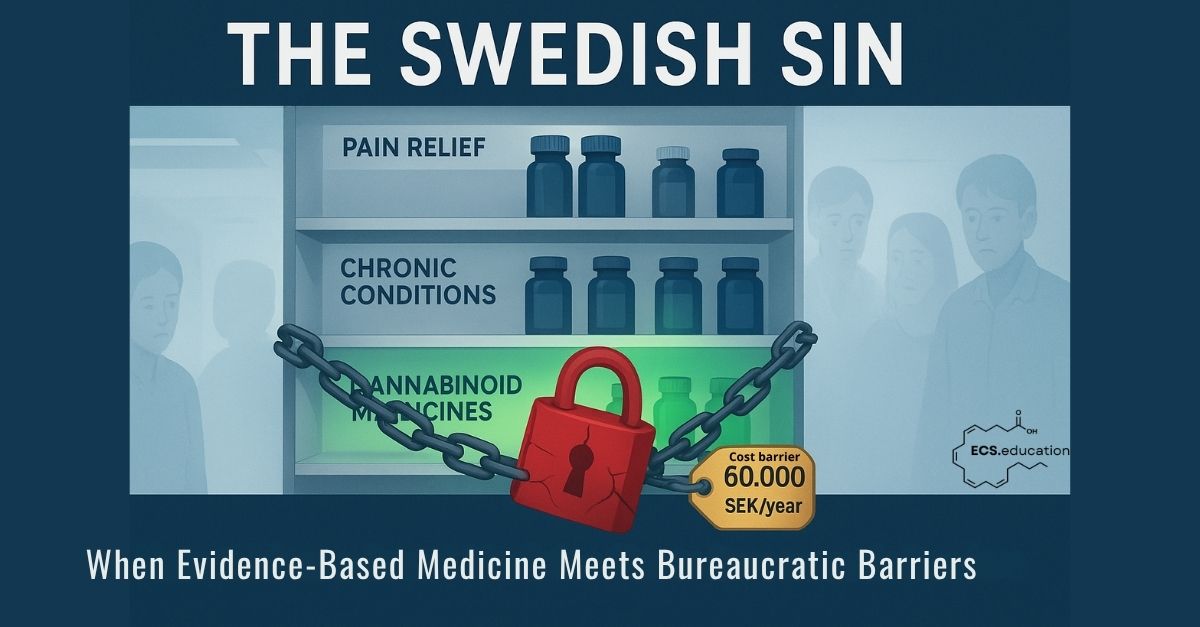
The Swedish Sin
Here’s a thing that’s been bothering me for months now. Sweden claims to have medical cannabis. We tell patients it’s “legal.” We point to regulations, to the framework, to the possibility. We hand them the illusion that they can access these medicines through the healthcare system if conventional treatments don’t work.
None of that is actually true. Not really. What we have instead is a charade so transparent it’s almost embarrassing.
The Dental and Pharmaceutical Benefits Agency (TLV) is currently deciding whether to exclude magistral cannabinoid preparations from Sweden’s high-cost protection scheme. If they go through with it, patients will overnight jump from paying 2,900 SEK annually (the high-cost protection cap) to 5,000–10,000 SEK per month out of pocket.
That’s roughly 60,000 SEK per year instead of 2,900 SEK.
TLV’s justification? Budget. Cost. Financial concerns. Money, basically.
What they haven’t done—what they haven’t even pretended to consider—is asking the people actually taking these medicines how this might affect their lives. Whether they can afford it. Whether pain management is a luxury good in Sweden now.
What they also haven’t mentioned is the minor detail that there are no approved cannabinoid medicines for chronic pain in Sweden. Zero. Nada. So when TLV says doctors should prescribe “approved alternatives,” they’re asking physicians to prescribe something that doesn’t exist, or to push patients toward opioids that actually kill people.
But logic and patient welfare are not driving this decision.
The Doctors’ Dilemma
Let’s talk about what it means to be a Swedish physician right now.
A friend working in healthcare recently told me something that clarified everything. An anesthesiologist, someone who manages pain every day, who has actually trained in pharmacology, said this:
“I cannot prescribe medical cannabis. All the medical regions have set the rule that it’s grounds for reprimand and dismissal if we do.”
Swedish physician
Read that again. This doctor has the legal right to prescribe. She’s trained. She’s competent. She’s seen the evidence. She knows her patients.
She still cannot do it without risking her career.
This is not a subtle thing. This is not a gray area. Region Skåne explicitly states [guidelines] that cannabinoid prescriptions are “discouraged” and limited to narrow specialist categories, with the clear implication that deviating will have consequences. They explicitly ‘discourage general prescribing of cannabinoids’ citing ‘very weak evidence’ and ‘high treatment cost’, not patient outcomes. They restrict prescribing to ‘exceptional cases’ by neurologists only. And this appears across multiple pain management guidelines: neuropathic pain, nociceptive pain. Cannabinoids are dismissed universally as ‘not recommended’ due to ‘limited and heterogeneous data.’

regional policy explicitly discourages general cannabinoid prescribing, citing “very
weak evidence base, risk of serious psychiatric side effects, and high treatment cost”—
notably prioritizing financial concerns over patient outcomes. Prescribing is restricted
to exceptional cases by neurologists or pediatric neurologists only. The document
confirms that “there are currently no approved medicines containing cannabinoids
included in [the high-cost protection scheme].
Meanwhile, treatments with comparable evidence quality face no such institutional hostility. The difference? Cannabis is politically radioactive.
Region Stockholm actually tried to shut down a clinic, not by proving malpractice, but by administratively revoking their workplace code. Took a court to reverse that, and they’re still fighting it.
The regions are using the weapons they have. Internal guidelines. Budget arguments. The threat of termination disguised as “policy compliance.” Workplace codes as administrative choke points.
These tools don’t require proving anything. They don’t require scientific debate. They’re blunt instruments of institutional control.
So what happens? Doctors who want to help their patients, who see a clear clinical indication for cannabinoid therapy, simply don’t prescribe. Self-censorship. It’s the rational response to an irrational situation. Why risk your career when you can just send the patient away?
This is how you kill a medical intervention without ever explicitly banning it.
The Real Problem: Nobody Knows What They’re Talking About
Here’s what I’ve come to understand: none of this makes sense because almost nobody actually understands what the endocannabinoid system is.
The ECS was discovered in the early 1990s [Devane et al., 1992]. That’s 35 years ago now. It is, without exaggeration, one of the most important regulatory systems in human biology. It touches pain signaling, inflammation, mood, metabolism, immune function, neuroprotection—basically everything that goes wrong in chronic disease.
And yet.
Go to any Swedish medical school. Look at the curriculum. The ECS is not there. Maybe a passing mention in pharmacology. Maybe nothing at all. You can graduate as a physician in Sweden in 2024 and have learned essentially nothing about the biological system you’re regulating with your prescribing decisions.
This is not an accident. This is institutional failure.
When doctors don’t learn about the ECS, they can’t do the job properly. They can’t understand why a patient might benefit from cannabinoid therapy. They can’t grasp the pharmacology. They default to the cultural narrative instead: cannabis = drugs = bad.
And it’s not just medical schools. Let me show you what counts as ‘ECS expertise’ in Swedish healthcare policy.
Janusinfo—Region Stockholm’s drug information service and one of Sweden’s primary sources for cannabinoid guidance—has a document called ‘Cannabis for Pain: Evidence Review.’ LINK
Here’s their ENTIRE description of the endocannabinoid system:

Pain: Evidence Review.” Despite being Sweden’s primary drug information service for
healthcare providers, the ECS explanation contains only historical discovery timeline
and anatomical receptor locations—with zero functional biology, zero clinical
application, and zero therapeutic strategy for chronic pain management. The annotated
checklist (bottom) highlights what’s missing: no explanation of what the ECS actually
does, why it matters for pain, how endocannabinoid tone varies, which patients might
benefit, or why individualized preparations matter. Source: Janusinfo, Region Stockholm.
That’s it. That’s the functional ECS explanation from Sweden’s ‘expert’ drug information service in a document specifically about cannabis for PAIN.
It’s a catalog of discoveries with zero functional biology, zero clinical application, zero therapeutic strategy.
Then Region Skåne (and many other regions) cites this same ‘expert’ source to justify why cannabinoids have ‘very weak evidence’ and shouldn’t be prescribed.
The circular reasoning is perfect:
Medical schools don’t teach the ECS → Doctors don’t understand it → ‘Expert’ groups
provide historical timelines instead of functional explanations → Doctors can’t evaluate
therapy properly → Regions cite ‘weak evidence’ → Access gets restricted → Patients suffer.
And everyone thinks they’re being evidence-based.

education in medical curricula creates a cascade effect: untrained physicians cannot
evaluate evidence, expert advisors provide incomplete guidance, policymakers cite gaps
in clinical application, regulators restrict access, and patients suffer. This feedback
loop prevents evidence-based medicine from reaching patients who need it.
When bureaucrats don’t understand the ECS, they make decisions like TLV’s.
When politicians don’t understand the ECS, you get a drug policy that prosecutes users at record rates while gang violence explodes.
The ignorance is so complete it looks coordinated. But it’s not coordination. It’s just everyone pretending to understand something nobody learned.
The Broken Math
Sweden spends €3.7 billion per year (0.78% of the entire GDP) enforcing drug policies that don’t work [Hofmarcher et al., 2023]
Let me repeat that: we spend three billion, seven hundred million euros per year, and the outcomes are far worse than countries that tried something different.
Sweden criminalizes users at record rates. We threaten doctors. We’re now deciding to make functional medicines financially inaccessible. And simultaneously, we’re watching violent gangs control the entire drug market, kill innocent people, and fracture urban areas into territories.
The policy doesn’t just fail, it produces exactly the outcomes it claims to prevent. It’s self-defeating on every metric except one: it feels morally pure to the people implementing it.
That’s actually the dangerous part. The moral certainty in the face of obvious failure.
The ECS Education Gap: How We Got Here
This problem has a name: the ECS is not taught in medical education because cannabis is politically radioactive.
It’s that simple. It’s not because the science is weak. It’s grown incredibly robust over the years. It’s not because there’s legitimate medical controversy—there isn’t, beyond normal scientific nuance. It’s because cannabis has carried so much cultural baggage for so long that institutions can’t separate the drug from the biology.
So you get this weird situation where:
- The ECS is fundamental biology
- Every medical student should understand it
- But if you mention cannabis, suddenly you’re “pro-drugs”
- So nobody mentions it
- So doctors don’t understand it
- So they can’t use it clinically
- So TLV can argue there’s insufficient clinical use to restrict access
- So patients suffer
It’s self-fulfilling prophecy as policy.
And here’s what really gets me: Swedish doctors want to learn this. There’s genuine hunger among practicing physicians to understand the ECS and how to apply it. They’re doing it on their own time, outside the formal system, because the formal system has failed them.
But every time a doctor steps forward to actually prescribe cannabinoids clinically (which is completely legal!) the regional apparatus comes down on them.
So you have education being driven underground while clinical application is administratively crushed. It’s a most backwards and absurd situation.
TLV’s Real Calculation
When TLV talks about “cost concerns,” they’re being literal but not honest.
Yes, there’s a cost: roughly 32 million kronor annually for about 1,200 patients with magistral cannabinoid prescriptions. That’s real money.
But TLV isn’t looking at the actual cost of their decision. They’re not calculating what happens when you force chronic pain patients off functional treatment:
- They go back to opioids, which have abuse and overdose risks, and which are killing an increasing number of Swedes.
- They become unable to work, increasing sick leave costs by orders of magnitude more than the medication savings.
- They end up in emergency care for exacerbated symptoms.
- They have worse quality of life and health outcomes.
- They lose trust in the healthcare system.
The math actually makes this decision worse from a financial perspective, if you calculate honestly.
But TLV’s math is simpler: medication line item goes down, looks like fiscal responsibility. Nobody’s tracking the downstream costs of making people’s chronic pain untreated.
That’s bureaucratic accounting, not healthcare accounting.
What It Actually Means
If TLV excludes cannabinoids from high-cost protection, you’re watching Sweden administratively ensure that only wealthy people can access these medicines.
And you’re doing it to patients who’ve already failed conventional treatments. People with chronic pain so severe that standard options don’t work. People who’ve presumably tried less expensive interventions first and ended up with magistral cannabinoid prescriptions because clinical judgement said that was the right call.
You’re saying: you don’t get access unless you can pay 60,000 kronor per year out of pocket.
That’s not policy. That’s rationing based on wealth. And it’s dressed up in cost-concern language to avoid saying that clearly.
The Bigger Picture (Or: Where Swedish Drug Policy Actually Lives)
This isn’t isolated. This is what Swedish drug policy looks like when you zoom out.
We prosecute cannabis users at one of the highest rates in Europe—mostly for personal possession. Meanwhile, we have Europe’s second-highest drug death rate [EMCDDA, 2024]. The contradiction is stark: punitive policy, disastrous outcomes.
But the response—from TLV, from regions, from politicians—is always more criminalization. More restriction. More administrative pressure.
It never occurs to anyone that maybe the approach is broken.
Sweden was supposed to be the evidence-based country. The rational place. The one that looked at data and adjusted policy accordingly. Instead, we’re watching a system double down on failure while calling it principles. That’s the real Swedish sin—not the policy, but the pretense.
Where ECS.education Comes In
I started ECS.education because this gap is insane.
The endocannabinoid system is not a political thing. It’s not an ideological position. It’s not a statement about whether cannabis should be legal or recreational use normalized. It’s biology. Actual, documented, well-understood biology.
And it’s being kept out of medical education because of cannabis politics.
That’s not acceptable. Not for patient care. Not for scientific integrity. Not for anything.
What ECS.education is doing:
Getting the ECS into medical school curricula where it belongs. Making it impossible for future physicians to graduate without understanding fundamental human biology. Training healthcare professionals in what the evidence actually says about endocannabinoid physiology and cannabinoid pharmacology. Supporting the doctors who are already trying to do this work. Amplifying patient voices that are being ignored by bureaucratic processes.
We’re building this slowly because institutional change is slow. But it’s happening. Doctors are beginning to ask for ECS education. Medical students are looking for high quality resources. Patients are connecting because they understand this gap exists and that it shouldn’t.
The system will change. It has to, because pretending the ECS doesn’t exist while people are suffering is not a sustainable position. We’re better than that.
What Needs to Happen
For TLV: Ask the patients. Actually. Not in a consultation that nobody reads, but real conversation about what exclusion from high-cost protection would mean. Then calculate the actual economic impact of forcing people off functional treatment.
For the regions: Stop threatening doctors for exercising their legal rights. If you think their clinical judgment is wrong, make that argument transparently. But this administrative punishment for prescribing approved medications is incredibly corrupting.
For medical schools: Add the ECS to the curriculum. It’s not optional anymore. It’s fundamental. The ECS is core physiology.
For doctors: Keep learning. Keep asking questions. The institutional barriers are real, but they’re not permanent.
For patients: Organize. Make your needs visible. TLV is currently operating in a knowledge vacuum where political convenience trumps your actual medical reality.
For Swedish citizens: Your drug policy is failing. Visibly. Measurably. The evidence is public. Ask your politicians why we’re maintaining a system that’s worse than alternatives.
The Bottom Line
The endocannabinoid system exists. It’s real. It’s biology, not politics.
Swedish policy is currently pretending it doesn’t exist. Or rather, pretending that acknowledging it would be politically dangerous. So we maintain bureaucratic structures designed to keep it hidden, keep doctors from using it, and keep patients from accessing it.
This works until it doesn’t. And it’s already not working.
TLV’s decision on high-cost protection is not about budget math. It’s about whether Sweden’s going to keep pretending that ignoring well-documented biology is the same as principled policy.
It’s not.
The ECS is there, whether we teach it or not. Patients benefit from cannabinoid therapy whether we approve of it or not. Doctors want to understand and use it whether we let them or not.
Fighting reality is exhausting. Eventually, everyone realizes there’s a better way.
The question is how many people suffer while we get there.
References
Devane WA, et al. Isolation and structure of a brain constituent that binds to
the cannabinoid receptor. Science. 1992;258(5090):1946-1949.
European Monitoring Centre for Drugs and Drug Addiction (EMCDDA).
European Drug Report 2024. https://www.emcdda.europa.eu/
Hofmarcher T, Leppänen A, Månsdotter A, Strandberg J, Håkansson A. Societal costs of illegal drug use in Sweden. Int J Drug Policy. 2024;123:104259. doi:10.1016/j.drugpo.2023.104259