• About WordPress
    • WordPress.org
    • Documentation
    • Learn WordPress
    • Support
    • Feedback
  • Log In
  • Register
Skip to content
Endocannabinoid Science Education Endocannabinoid Science Education

ECS is Physiology

  • What?
  • Why?
  • How?
  • Where?
  • Contact
  • Advisory Board
  • Forums
  • Blog
  • Bio
  • ECS Explained
Endocannabinoid Science Education

ECS is Physiology

Tag: substrate-driven ECS

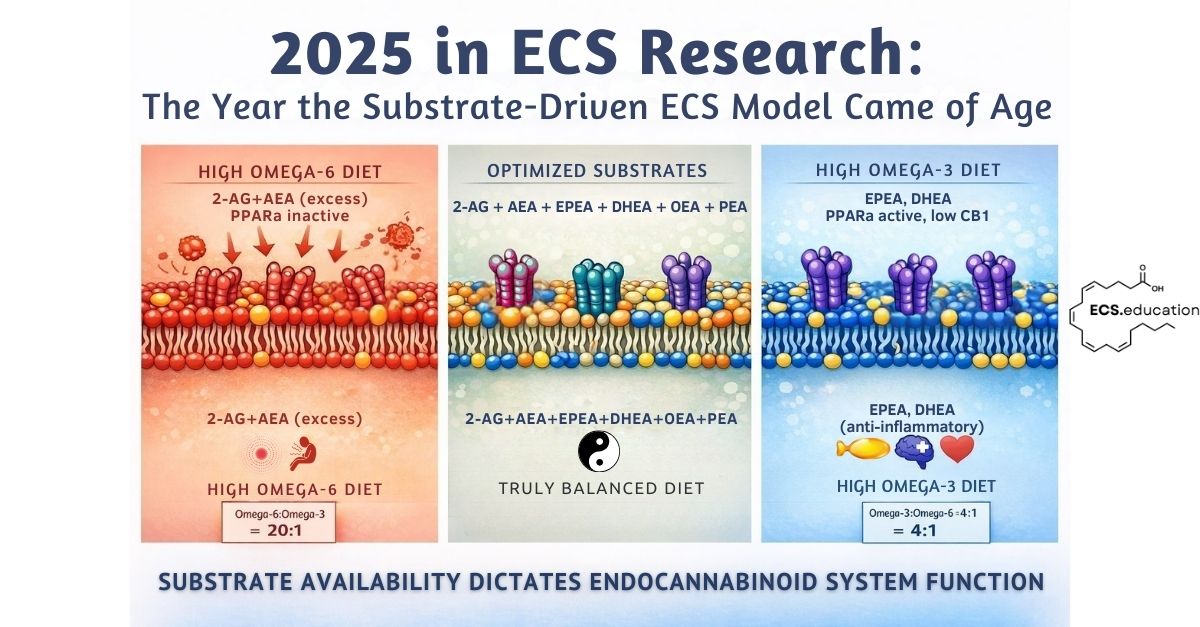
Endocannabinoid System (ECS) Three-panel scientific illustration comparing endocannabinoid system function across three dietary states. Left panel: High omega-6 diet showing excess CB1 receptor stress and 2-AG/AEA production (omega-6:omega-3 ratio 20:1). Center panel: Optimized substrates with balanced membrane composition supporting multiple endocannabinoid types and receptor function. Right panel: High omega-3 diet showing activated TRPV1/TRPA1 ion channels, PPARα activation, and anti-inflammatory endocannabinoid production (omega-3:omega-6 ratio 4:1). Bottom tagline: Substrate availability dictates endocannabinoid system function.

2025 in ECS Research: The Year the Substrate-Driven ECS Model Came of Age

Posted on December 28, 2025December 28, 2025 By Stefan Broselid

Endocannabinoid system substrate—specifically membrane fatty acid composition—is the primary determinant of CB1 receptor function, not genetics or receptor density. For years, I’ve been making the case that endocannabinoid system function is not primarily about receptor density or genetic variants, it’s about substrate availability. The composition of fatty acids in cell…

Read more
Endocannabinoid System (ECS) Diagram showing how diet and exercise modulate brain endocannabinoid system through substrate dynamics. Left: Western diet activates PLA2 leading to CB1 changes. Center: Brain with reduced hypothalamic and increased cortical CB1 receptors labeled. Right: Exercise activates PLA2 similarly. Bottom text states outcome of regional CB1 receptor changes.

How Diet and Exercise Modulate the Endocannabinoid System

Posted on November 5, 2025November 5, 2025 By Stefan Broselid

New Evidence for the Substrate-Driven Model I came across a fascinating recent study this week in Nutritional Neuroscience that really validates something I’ve been thinking about for a while. Lima and colleagues just published research showing how diet and exercise reshape the endocannabinoid system in the brain. It all fits beautifully with what I call the substrate-driven model of ECS function. Let me walk you through what they found and why it matters. The Study: Diet, Exercise & Brain ECS The team took young rats and divided them into groups. Some got standard lab chow, others got a “palatable diet” (think: high in omega-6 fats and sugar, like a Western diet). Some rats didtreadmill training for eight weeks, others didn’t. Then they looked at CB1 receptors and NAPE-PLD enzyme levels in three key brain areas: • Hypothalamus – your energy regulation center • Frontal cortex – handles reward and decision-making…

Read more
©2026 Endocannabinoid Science Education | WordPress Theme by SuperbThemes